Showing posts with label Week 067. Show all posts

Friday, July 18, 2025

Greek Crossword 40-41-42

Here is the review for proverbs in groups 40-41-42 with the crossword puzzle! You can click on those group links to review those posts and/or click on the linked sayings below for the post with that specific saying:
Here are the sayings without spaces: see if you can find the word breaks! (I'm just doing the shorter ones because the long ones just keep running over longer than the line.)

α υ τ ο σ α υ τ ο ν α υ λ ε ι.

α λ κ η σ τ ι δ ο σ α ν δ ρ ε ι α.

α π α σ ε χ ι ν ο σ τ ρ α χ υ ς.

π ρ ε σ β υ τ ε ρ ο σ κ ο δ ρ ο υ.

β ε β α ι ο ν ο υ δ ε ν ε σ τ ι ν ε ν θ ν η τ ῳ β ι ῳ.

σ ι γ η π ο τ ε σ τ ι ν α ι ρ ε τ ω τ ε ρ α λ ο γ ο υ.

τ υ χ η τ ε χ ν η ν ο ρ θ ο ι ο υ τ ε χ ν η τ υ χ η ν.


And here's the crossword puzzle based on a missing word from each proverb: printable Crossword PDF. I've pasted in screenshots below so you can see what the crossword looks like:

And here's a random proverb and a random LOLCat too :


Click here to subscribe/unsubscribe to the email list.


Thursday, July 17, 2025

Philogelos compendium

Today's post is a bit different: it's a review of the Philogelos jokes that I shared in previous posts drawn from various Greek readers. I'm about to start on a Philogelos project with Hector Tapia (grad student at UC Davis working on Aesopic humor and other jokes), and it may result in a reader for students, so I wanted to see what stories I had found in the old textbooks thus far.

Below you will find a list of titles linked to their blog posts, and you can also find all that content copied-and-pasted into this document: Philogelos jokes from old Greek textbooks. There are 58 of these little jokes, so that is already a good start! Having them all in one place lets you search the document for a keyword, for example, if you want to find all the donkeys or doctors, all the references to slaves, etc.

For more Philogelos jokes in Greek (there are over 250 total!), see You've Got to Be Joking: An English Translation of the Philogelos by Annie McCabe, an undergraduate (!) thesis available for download at New College of Florida.

I also found some Philogelos cartoons online at the Language Museum. This one Τίς ὁ τεθνηκώς; (the cartoon is in English, but it includes the Greek text below).

These are links to past blog posts:
  1. Ἀβδηρίτης καὶ ἰατρός
  2. Ἀβδηρίτης καὶ χοιρίδιον
  3. Ἀβδηρίτης τις κολυμβῶν
  4. Ἀβδηρίτου στρουθίον
  5. Αἱ πύλαι τῶν Ἀβδήρων
  6. Δειλὸς κυνηγὸς
  7. Δίδυμοι ἀδελφοί
  8. Δικαίως μωροὶ καλούμεθα
  9. Δύσκολος ἰατρός
  10. Δύσκολὸς καὶ δοῦλος
  11. Ἔμαθον ὅτι ἀπέθανες
  12. Ἐπὶ δεῖπνον κληθείς
  13. Ἡ λεκάνη μὴ ἔχουσα ὠτία
  14. Ἡ λήκυθος
  15. Ἡ μήτηρ Πριάμου
  16. Ἡ περὶ τῶν βιβλίων ἐπιστολή
  17. Καθ' ὕπνους ἰδὼν
  18. Κριτήρια ἐν ᾍδου
  19. Κυμαῖος ἰατρὸς
  20. Κυμαῖος καὶ συκῆ
  21. Κυμαῖός τις ἐν τῷ κολυμβᾶν
  22. Κυμαῖός τις μέλι ἐπώλει
  23. Ὀκνηρὸς υἱός
  24. Ὃν ἐπώλησάς μοι δοῦλον
  25. Ὄνος καὶ ἔλαιον
  26. Πλοῖα ἀσφαλέστερα
  27. Προσκεφάλαιον
  28. Σιδώνιος σχολαστικός
  29. Σχολαστικοὶ δύο καὶ μέλαινα ὄρνις
  30. Σχολαστικὸς ἰατρῷ συναντήσας
  31. Σχολαστικὸς καὶ ἀδελφοὶ δύο
  32. Σχολαστικὸς καὶ διδάσκαλος
  33. Σχολαστικὸς καὶ θρέμματα
  34. Σχολαστικὸς καὶ ἰατρός
  35. Σχολαστικός καὶ κλῖμαξ
  36. Σχολαστικὸς καὶ κόραξ
  37. Σχολαστικὸς καὶ κουρεύς
  38. Σχολαστικὸς καὶ οἰκία
  39. Σχολαστικὸς καὶ οἶνος
  40. Σχολαστικὸς καὶ ὄνος
  41. Σχολαστικὸς καὶ πώγων
  42. Σχολαστικὸς καὶ σελήνη
  43. Σχολαστικός καὶ στρουθοί
  44. Σχολαστικὸς καὶ τὰ βιβλία αὑτοῦ
  45. Σχολαστικὸς καὶ φρέαρ
  46. Σχολαστικὸς μαχόμενος τῷ πατρὶ
  47. Σχολαστικὸς ναυαγεῖν μέλλων
  48. Σχολαστικὸς ναυαγῶν
  49. Σχολαστικὸς νοσοῦντα ἐπισκεπτόμενος
  50. Σχολαστικὸς νοσῶν καὶ γυνὴ
  51. Σχολαστικὸς οἰκίαν πωλῶν
  52. Σχολαστικὸς πεπαιδευμένος
  53. Σχολαστικός τις ἐνοπτρίζεται
  54. Σχολαστικός τις καὶ ποταμός
  55. Σχολαστικοῦ υἱὸς
  56. Τίς ὁ τεθνηκώς;
  57. Ὑὸς κεφαλή
  58. Φιλάργυρος

So, enjoy the jokes, and I'll be back next week with more stories from the old readers.

Plus here's a random proverb and a random LOLCat too:


Click here to subscribe/unsubscribe to the email list.


Wednesday, July 16, 2025

Greek Animal Vocabulary: July 17

Here are today's animal names; it's Group 183. Click on the word to learn more at Logeion:

ὗς ~ ὑός (noun c.): pig 
γαλέη ~ γαλέης (noun f.): weasel 
λύκος ~ λύκου (noun m.): wolf 
λαγώς ~ λαγώ (noun m.): hare 
μύρμηξ ~ μύρμηκος (noun m.): ant 

These are the proverbs (and there are always more proverbs at the blog):

Βοιωτία ὗς.

Γαλῆν ἔχεις.

Λύκος καλεῖ τὰς αἶγας.

Δειλότερος εἶ τῶν λαγωῶν.

Οὐαὶ μύρμηκι πτεροῖς ἀρθέντι.

And now, some commentary:

Βοιωτία ὗς.
A Boeotian pig.
This saying brings together two proverbially ignorant creatures: someone from Boeotia, and a pig. Combine the two, and you've got someone who is totally ignorant. You've already seen a proverb mocking the people of Boeotia in a previous post: Βοιώτιος νοῦς. You've also seen a saying mocking the ignorance of the foolish pig who dares to rival the goddess of wisdom in this post from last week: Ὗς πότ᾽ Ἀθηναίαν ἔριν ἤρισεν.

Γαλῆν ἔχεις.
You've got the weasel.
The weasel was a very bad omen, so telling someone that they have a weasel means that they are unlucky and going to get into trouble as a result. Compare the evil omen of a black cat crossing your path in English; there is a lot of folkloric overlap between weasels and cats (the ancient Greeks kept weasels in their houses to control mice; later, they adopted the Egyptian practice of keeping cats as pets).

Λύκος καλεῖ τὰς αἶγας.
The wolf is calling the goats.
The goats would be very foolish indeed if they came to the wolf when he called to them. Of course the wolf is going to try to trick the goats; it's up to the goats to know better and watch out. So, if you're a metaphorical goat, beware!

Δειλότερος εἶ τῶν λαγωῶν.
You are more cowardly than the rabbits.
There is an Aesop's fable about the proverbial cowardice of rabbits, but in the Aesop's fable, the rabbits are comforted by the fact that the frogs are even more scared than they are; here's that fable in Greek: Λαγωοὶ καὶ βάτραχοι.

Οὐαὶ μύρμηκι πτεροῖς ἀρθέντι.
Woe to the ant equipped with wings.
This proverb suggests a lost Aesop's fable; there are often connections between the plots of Aesop's fables and ancient Greek proverbs featuring animals, like this one. Inspired by this proverb, the neo-Latin poet Desbillons wrote a story about foolish ants who asked Zeus to give them wings, but then they became food for birds. Here's the story in Latin (I don't think Desbillons has been translated into English...?): Formica et Jupiter.


And here's a random proverb and a random LOLCat too:


Click here to subscribe/unsubscribe to the email list.


Tuesday, July 15, 2025

Greek Reading: 85

Today's stories come from Colson's Stories and Legends: A First Greek Reader which is available at the Internet Archive. 

You'll find the stories below, first in Greek, then segmented, and then interwoven with English; the title is linked to the Internet Archive page.


ἀνὴρ ἐθεάσατο ὄφιν ὑπὸ τοῦ χειμῶνος ἀπολλύμενον. ἐλεήσας δὲ ἐς τὸν κόλπον ἔθηκε. καὶ πρῶτον μὲν ἡσύχαζεν: ὑπὸ γὰρ τοῦ κρύους ἐνάρκα. ἔπειτα θερμὸς γενόμενος δάκνει τὴν γαστέρα τοῦ ἀνδρός. ὁ δὲ μέλλων ἀποθνήσκειν ἔφη, δίκαια μέντοι πάσχω, ὃς τὸν πονηρὸν ᾦκτειρα.

ἀνὴρ ἐθεάσατο ὄφιν 
ὑπὸ τοῦ χειμῶνος ἀπολλύμενον. 
ἐλεήσας δὲ 
ἐς τὸν κόλπον ἔθηκε. 
καὶ πρῶτον μὲν ἡσύχαζεν: 
ὑπὸ γὰρ τοῦ κρύους ἐνάρκα. 
ἔπειτα θερμὸς γενόμενος 
δάκνει τὴν γαστέρα τοῦ ἀνδρός. 
ὁ δὲ μέλλων ἀποθνήσκειν ἔφη, 
δίκαια μέντοι πάσχω, 
ὃς τὸν πονηρὸν ᾦκτειρα.

ἀνὴρ ἐθεάσατο ὄφιν  ...  A man saw a snake 
ἀπολλύμενον  ...  perishing
ὑπὸ τοῦ χειμῶνος  ...  in the winter cold.
ἐλεήσας δὲ  ...  Feeling sorry for the snake 
ἐς τὸν κόλπον ἔθηκε  ...  he put it in his cloak. 
καὶ πρῶτον μὲν ἡσύχαζεν  ...  At first it was quiet,  
ὑπὸ γὰρ τοῦ κρύους ἐνάρκα  ...  being stiff with cold. 
ἔπειτα θερμὸς γενόμενος  ...  But when it warms up,
δάκνει τοῦ ἀνδρός  ...  it bites the man
τὴν γαστέρα  ...  in the belly.
ὁ δὲ ἔφη  ...  And the man said
μέλλων ἀποθνήσκειν  ...  as he was about to die, 
δίκαια μέντοι πάσχω  ...  I suffer what is just
ὃς ᾦκτειρα  ...  since I pitied 
τὸν πονηρὸν  ...  someone wicked.


τυφλῷ τινι γέροντι μικρὸς κύων ἦν. οὗτος δὲ κανοῦν περιφέρων, συνέλεγε σιτία καὶ ἄργυρον. ἀπὸ δὲ τούτων ἐτρέφετο ὁ γέρων. καὶ ἧκεν ποτε ὁ κύων ἐς τὴν οἰκίαν τινὸς ἀρτάμου. ὁ δὲ ἄρταμος, ὠμὸς γὰρ ἀνὴρ ἦν, εἶπε τῷ κυνί, σὺ δὴ δοκεῖς κρέας αἰτεῖν· ἔσται σοι ὃ βούλει. ἀποκόψας οὖν τὴν οὐρὰν τοῦ κυνός, ἐνέθηκε τῷ κανῷ. καὶ ὁ κύων φέρει μὲν οἴκαδε τὸ κανοῦν, ἔπειτα δὲ ἀποθνήσκει.

τυφλῷ τινι γέροντι 
μικρὸς κύων ἦν. 
οὗτος δὲ κανοῦν περιφέρων, 
συνέλεγε σιτία καὶ ἄργυρον. 
ἀπὸ δὲ τούτων ἐτρέφετο ὁ γέρων. 
καὶ ἧκεν ποτε ὁ κύων 
ἐς τὴν οἰκίαν τινὸς ἀρτάμου. 
ὁ δὲ ἄρταμος, 
ὠμὸς γὰρ ἀνὴρ ἦν, 
εἶπε τῷ κυνί, 
σὺ δὴ δοκεῖς κρέας αἰτεῖν· 
ἔσται σοι ὃ βούλει. 
ἀποκόψας οὖν 
τὴν οὐρὰν τοῦ κυνός, 
ἐνέθηκε τῷ κανῷ. 
καὶ ὁ κύων 
φέρει μὲν οἴκαδε τὸ κανοῦν, 
ἔπειτα δὲ ἀποθνήσκει.

τυφλῷ τινι γέροντι  ...  A blind old man
μικρὸς κύων ἦν  ...  had a little dog. 
οὗτος δὲ  ...  The dog
κανοῦν περιφέρων  ...  carried around a basket, 
συνέλεγε  ... and collected
σιτία καὶ ἄργυρον  ...  food and money. 
ἀπὸ δὲ τούτων  ... That is what
ἐτρέφετο ὁ γέρων  ...  the old man lived on.
καὶ ἧκεν ποτε ὁ κύων  ...  Once the dog came 
ἐς τὴν οἰκίαν  ...  to the house
τινὸς ἀρτάμου  ...  of a butcher.
ὁ δὲ ἄρταμος  ...  The butcher, 
ὠμὸς γὰρ ἀνὴρ ἦν  ...  because he was a cruel man, 
εἶπε τῷ κυνί  ...  said to the dog, 
σὺ δὴ δοκεῖς αἰτεῖν  ...  You seem to be asking me 
κρέας  ...  for meat.
ἔσται σοι ὃ βούλει  ...  This will give you what you want. 
ἀποκόψας οὖν  ...  And so he cut off 
τὴν οὐρὰν τοῦ κυνός  ...  the dog's tail
ἐνέθηκε τῷ κανῷ  ...  and put it in the basket. 
καὶ ὁ κύων  ...  And the dog 
φέρει μὲν τὸ κανοῦν  ...  carries the basket
οἴκαδε  ...  home, 
ἔπειτα δὲ ἀποθνήσκει  ...  and then dies.

(This one comes from Germany, and this "Dog of Bretten" story appears in quite different versions; here's just one of them: The Tailless Dog.)


And here's a random proverb and a random LOLCat too:


Click here to subscribe/unsubscribe to the email list.


Monday, July 14, 2025

Greek Animal Vocabulary: July 15

Here are today's animal names; it's Group 182. Click on the word to learn more at Logeion:

κόραξ ~ κόρακος (noun m.): crow 
λέων ~ λέοντος (noun m.): lion 
πέρδιξ ~ πέρδικος (noun c.): partridge 
βοῦς ~ βοός (noun c.): ox, cow 
δασύπους ~ δασύποδος (noun m.): rabbit, hare

These are the proverbs (and there are always more proverbs at the blog):

Ἐς κόρακας.

Λέοντα νύσσεις.

Ἀφωνότερος πέρδικος.

Τὸν θέλοντα βοῦν ἔλαυνε.

Καρκίνον δασύποδι συγκρίνεις.


And now, some commentary:

Ἐς κόρακας.
To the crows.
This is an insult: the crows are the crows who feed on the corpses at public executions. So, the idea is to "go hang yourself" — and then the crows will come feast. You can see the phrase used in Aristophanes' Peace.

Λέοντα νύσσεις.
You're poking the lion.
More specifically, the verb means to poke something with a sharp stick. Obviously this is NOT something you want to do to a lion. Compare the English saying, "Poke the bear."

Ἀφωνότερος πέρδικος.
More speechless than a partridge.
You can see that the adjective is an alpha-privative: ἄ-φωνος, comparative ἀφωνότερος. The saying appears in an essay in Plutarch's Moralia.

Τὸν θέλοντα βοῦν ἔλαυνε.
Lead the ox that is willing.
In other words: don't lead the ox who is not willing! You can see that idea in a fuller form of the saying which is included in the proverb collection attributed to Aesop: Τὸν θέλοντα βοῦν ἔλαυνε, τὸν μὴ θέλοντα ἔα, "Lead the ox that is willing, leave the unwilling one alone."

Καρκίνον δασύποδι συγκρίνεις.
You're comparing a crab to a rabbit.
Crabs were notorious for their slow and ungainly walk, utterly unlike the fast-running hare or rabbit. So, this saying means you're making a ridiculous comparison, like "apples to oranges" in English. The word δασύπους, "shaggy-foot," was a popular nickname for the hare or rabbit.


And here's a random proverb and a random LOLCat too:


Click here to subscribe/unsubscribe to the email list.


Greek Reading: 84

Today's stories come from Colson's Stories and Legends: A First Greek Reader which is available at the Internet Archive. 

You'll find the stories below, first in Greek, then segmented, and then interwoven with English; the title is linked to the Internet Archive page.


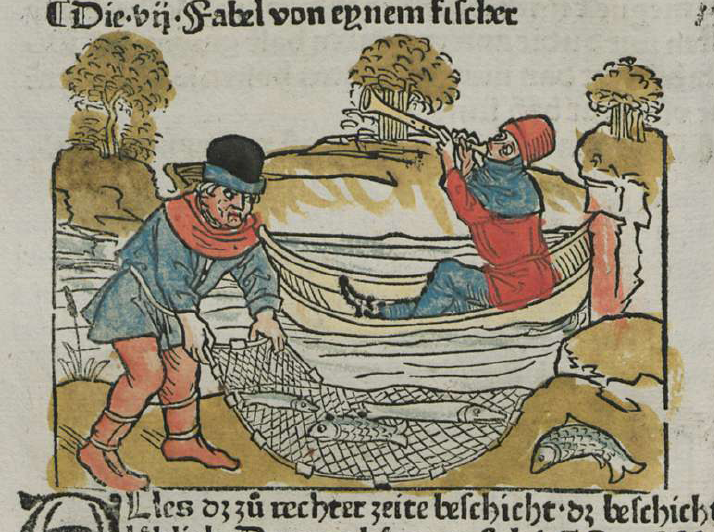
ἀνὴρ αὐλητής, ἰδὼν ἰχθῦς ἐν τῇ θαλάσσῃ, ηὔλει νομίζων αὐτοὺς ἀποβήσεσθαι ἐς τὴν γῆν· ἐπεὶ δὲ οὐκ ἐξέβησαν, λαβὼν δίκτυον, πολλοὺς ἤγρευσεν· ἰδὼν δὲ παλλομένους, ἔφη, ὦ κάκιστοι ἰχθῦς, ὅτε μὲν ηὔλουν, οὐκ ὠρχεῖσθε, νῦν δέ, ὅτε πέπαυμαι, τοῦτο πράσσετε.

ἀνὴρ αὐλητής, 
ἰδὼν ἰχθῦς ἐν τῇ θαλάσσῃ, 
ηὔλει 
νομίζων 
αὐτοὺς ἀποβήσεσθαι 
ἐς τὴν γῆν· 
ἐπεὶ δὲ οὐκ ἐξέβησαν, 
λαβὼν δίκτυον, 
πολλοὺς ἤγρευσεν· 
ἰδὼν δὲ παλλομένους, 
ἔφη, 
ὦ κάκιστοι ἰχθῦς, 
ὅτε μὲν ηὔλουν, 
οὐκ ὠρχεῖσθε, 
νῦν δέ, 
ὅτε πέπαυμαι, 
τοῦτο πράσσετε.

ἀνὴρ αὐλητής  ...  A flute-player 
ἰδὼν ἰχθῦς  ...  saw some fish
ἐν τῇ θαλάσσῃ  ...  in the sea 
ηὔλει  ...  and played his flute,
νομίζων  ...  thinking
αὐτοὺς ἀποβήσεσθαι  ...  the fish would come out 
ἐς τὴν γῆν  ...  onto the land.
ἐπεὶ δὲ οὐκ ἐξέβησαν  ...  But when they didn't come out, 
λαβὼν δίκτυον  ...  he took a net, 
πολλοὺς ἤγρευσεν  ...  and caught many fish. 
ἰδὼν δὲ παλλομένους  ...  And when he saw them wriggling 
ἔφη  ...  he said, 
ὦ κάκιστοι ἰχθῦς  ...  O you wretched fish!
ὅτε μὲν ηὔλουν  ...  When I played the flute, 
οὐκ ὠρχεῖσθε  ...  you did not dance, 
νῦν δέ  ...  but now,
ὅτε πέπαυμαι  ...  when I've stopped playing, 
τοῦτο πράσσετε  ...  you're doing the dance.


ὁ κόραξ, κρέας ἔχων, ἐπὶ δένδρῳ ἐκάθιζξεν. ἡ δὲ ἀλώπηξ ὑπελθοῦσα τὸ δένδρον, ἐπἤνει αὐτὸν ὡς κάλλιστον ὄντα τῶν ὀρνίθων. ἔδει σε γάρ, ἔφη, πάντων βασιλεύειν, καὶ τοῦτο πάντως σοι ἂν ἐγίγνετο εἰ φωνὴν εἶχες." ὁ δὲ κόραξ, “πῶς λέγεις,᾽ ἔφη, “ὅτι φωνὴν οὐκ ἔχω; καὶ ταῦτα λέγων καταβάλλει τὸ κρέας ἀπὸ τοῦ στόματος. ἡ δὲ ἀλώπηξ ἁρπάσασα τὸ κρέας, εἴπεν “ ὦ κόραξ, ἔχεις μὲν ἄρα τὴν φωνήν, τὸν δὲ νοῦν οὐκ ἔχεις."

ὁ κόραξ, 
κρέας ἔχων, 
ἐπὶ δένδρῳ ἐκάθιζξεν. 
ἡ δὲ ἀλώπηξ 
ὑπελθοῦσα τὸ δένδρον, 
ἐπἤνει αὐτὸν 
ὡς κάλλιστον ὄντα 
τῶν ὀρνίθων. 
ἔδει σε γάρ, 
ἔφη, 
πάντων βασιλεύειν, 
καὶ τοῦτο 
πάντως σοι ἂν ἐγίγνετο 
εἰ φωνὴν εἶχες." 
ὁ δὲ κόραξ, 
“πῶς λέγεις,᾽ 
ἔφη, 
“ὅτι φωνὴν οὐκ ἔχω; 
καὶ ταῦτα λέγων 
καταβάλλει τὸ κρέας 
ἀπὸ τοῦ στόματος. 
ἡ δὲ ἀλώπηξ 
ἁρπάσασα τὸ κρέας, 
εἴπεν 
“ὦ κόραξ, 
ἔχεις μὲν ἄρα τὴν φωνήν, 
τὸν δὲ νοῦν οὐκ ἔχεις."

ὁ κόραξ  ...  The crow, 
κρέας ἔχων  ...  had gotten some meat
ἐπὶ δένδρῳ ἐκάθιζξεν  ...  and sat upon a tree.
ἡ δὲ ἀλώπηξ  ...  The fox
ὑπελθοῦσα τὸ δένδρον  ...  came to the tree 
ἐπἤνει αὐτὸν  ...  and praised the crow 
ὡς κάλλιστον ὄντα  ...  for being the most beautiful 
τῶν ὀρνίθων  ...  among the birds.
ἔφη  ...  The fox said, 
ἔδει σε γάρ  ...  You should have been
πάντων βασιλεύειν  ...  the one to rule over all, 
καὶ τοῦτο πάντως  ...  and this for sure
σοι ἂν ἐγίγνετο  ...  would have happened to you 
εἰ φωνὴν εἶχες  ...  if you had a voice. 
ὁ δὲ κόραξ ἔφη  ...  And the crow said, 
πῶς λέγεις,  ...  How can you say 
ὅτι φωνὴν οὐκ ἔχω  ...  that I don't have a voice? 
καὶ ταῦτα λέγων  ...  And saying this, 
καταβάλλει τὸ κρέας  ...  the crow dropped the meat 
ἀπὸ τοῦ στόματος  ...  from his mouth. 
ἡ δὲ ἀλώπηξ  ...  And the fox 
ἁρπάσασα τὸ κρέας  ...  seized the meat 
εἴπεν  ...  and said, 
ὦ κόραξ  ...  O crow, 
ἔχεις μὲν ἄρα  ...  you do indeed have
τὴν φωνήν  ...  a voice, 
τὸν δὲ νοῦν οὐκ ἔχεις  ...  but you don't have a brain.


And here's a random proverb and a random LOLCat too:


Click here to subscribe/unsubscribe to the email list.