Showing posts with label Week 051. Show all posts

Friday, March 28, 2025

Proverbs Slideshow/Crossword: March 29

For today, it's a new review slideshow for Groups 143, 144, and 145. Here's the post with the details about how the slideshows work, and there's a random cat at the bottom of the post! Plus more cats.

The slideshow is embedded in the blog post, and you can also access today's slideshow directly, full-sized view. And remember: each time you see the English translation on a slide, you can click to access the original blog post with the notes for each proverb.


There's also a crossword puzzle PDF that you can print; here's a screenshot of the puzzle and key. :-)


These are the proverbs, linked back to their blog post:
  1. Ἀρχὴ ἥμισυ παντός.
  2. Γενεὰ πορεύεται καὶ γενεὰ ἔρχεται.
  3. Δίκην ὑφέξει κἂν ὄνος δάκῃ κύνα.
  4. Ἐν ἀμούσοις καὶ κόρυδος φθέγγεται.
  5. Ἡ σοφίας πήγη διὰ βιβλίων ῥεῖ.
  6. Ἱκέτας αἰδοῦ.
  7. Ὀφθαλμοὶ τῶν ὤτων ἀκριβέστεροι μάρτυρες.
  8. Πολλαῖς πληγαῖς δρῦς δαμάζεται.
  9. Πολλοὶ μαθηταὶ κρείττονες διδασκάλων.
  10. Σιγηροῦ ποταμοῦ τὰ βάθη γυρεύει.
  11. Σοφία δὲ πλούτου κτῆμα τιμιώτερον.
  12. Σοφῷ γὰρ αἰσχρὸν ἐξαμαρτάνειν.
  13. Τὰ καίσαρος ἀπόδοτε καίσαρι καὶ τὰ τοῦ θεοῦ τῷ θεῷ.
  14. Τῶν γὰρ πενήτων εἰσὶν οἱ λόγοι κενοί.
  15. Ὗς λουσαμένη εἰς κυλισμὸν βορβόρου.

And here's a random proverb and a random LOLCat too :


Click here to subscribe/unsubscribe to the email list.


Thursday, March 27, 2025

Greek Reading: Fables 39

Today's fables and also the joke come from Colton's Greek Reader, which has notes for the stories and a vocabulary in the back; the book is available at the Internet Archive. 

So, here are the stories in Greek, then segmented, and then interwoven with English. The titles are linked to the Internet Archive page.


Ἔν τινι ἐπαύλει ὄνος καὶ ἀλεκτρυὼν ἦσαν. Λέων δὲ λιμώττων, ὡς ἐθεάσατο τὸν ὄνον, οἷός τε ἦν, εἰσελθὼν ἤμελλε καταθοινήσασθαι. Περὶ δὲ τὸν ψόφον, ἀλεκτρυόνος φθεγξαμένου καταπτήξας, φασὶ γάρ τοὺς λέοντας πτύρεσθαι πρὸς τὰς τῶν ἀλεκτρυόνων φωνὰς, εἰς φυγὴν ἐτράπη. Καὶ ὁ ὄνος ἀναπτερωθεὶς κατ' αὐτοῦ, εἴγε ἀλεκτρυόνα ἐφοβήθη, ἐξῆλθεν ὡς ἀποδιώξων αὐτόν. Ὁ δὲ, ὡς μακρὰν ἐγένετο, κατέφαγεν αὐτόν.

Ἔν τινι ἐπαύλει 
ὄνος καὶ ἀλεκτρυὼν ἦσαν. 
Λέων δὲ λιμώττων, 
ὡς ἐθεάσατο τὸν ὄνον, 
οἷός τε ἦν, 
εἰσελθὼν 
ἤμελλε καταθοινήσασθαι. 
Περὶ δὲ τὸν ψόφον, 
ἀλεκτρυόνος φθεγξαμένου 
καταπτήξας, 
φασὶ γάρ 
τοὺς λέοντας πτύρεσθαι 
πρὸς τὰς τῶν ἀλεκτρυόνων φωνὰς, 
εἰς φυγὴν ἐτράπη. 
Καὶ ὁ ὄνος 
ἀναπτερωθεὶς κατ' αὐτοῦ, 
εἴγε ἀλεκτρυόνα ἐφοβήθη,
ἐξῆλθεν 
ὡς ἀποδιώξων αὐτόν. 
Ὁ δὲ, 
ὡς μακρὰν ἐγένετο, 
κατέφαγεν αὐτόν.

Ἔν τινι ἐπαύλει  ... On a farmstead 
ὄνος καὶ ἀλεκτρυὼν ἦσαν  ... there was a donkey and rooster. 
Λέων δὲ λιμώττων  ... A hungry lion 
ὡς ἐθεάσατο τὸν ὄνον  ... when he saw the donkey, 
οἷός τε ἦν εἰσελθὼν  ... and being as he was (a lion), he went in
ἤμελλε καταθοινήσασθαι  ... and planned to have a feast. 
Περὶ δὲ τὸν ψόφον  ... But because of the noise
ἀλεκτρυόνος φθεγξαμένου  ... of the rooster squawking,
καταπτήξας  ... the lion cowered — 
φασὶ γάρ  ... for they say
τοὺς λέοντας πτύρεσθαι  ... that lions are terrified  
πρὸς τὰς τῶν ἀλεκτρυόνων φωνὰς  ... by roosters crowing — 
εἰς φυγὴν ἐτράπη  ... he turned around to run. 
Καὶ ὁ ὄνος  ... And the donkey 
ἀναπτερωθεὶς κατ' αὐτοῦ  ... felt elated because of this,
εἴγε ἀλεκτρυόνα ἐφοβήθη  ... since the lion feared the rooster,
ἐξῆλθεν  ... and went out 
ὡς ἀποδιώξων αὐτόν  ... in pursuit of the lion. 
Ὁ δὲ  ... But the lion, 
ὡς μακρὰν ἐγένετο  ... when he was far (from the rooster),
κατέφαγεν αὐτόν  ... devoured the donkey.


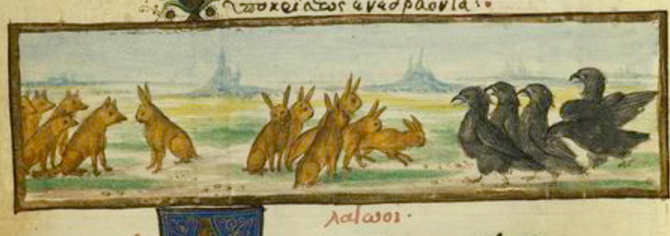
Λαγωοί ποτε πολεμοῦντες ἀετοῖς, παρεκάλουν εἰς συμμαχίαν ἀλώπεκας. Αἱ δὲ ἔφασαν· Ἐβοηθήσαμεν ἂν ὑμῖν, εἰ μὴ εἴδειμεν, τίνες ἦτε καὶ τίσι πολεμεῖτε.

Λαγωοί ποτε 
πολεμοῦντες ἀετοῖς, 
παρεκάλουν εἰς συμμαχίαν ἀλώπεκας. 
Αἱ δὲ ἔφασαν· 
Ἐβοηθήσαμεν ἂν ὑμῖν, 
εἰ μὴ εἴδειμεν, 
τίνες ἦτε καὶ τίσι πολεμεῖτε.

Λαγωοί ποτε  ... The rabbits once upon a time
πολεμοῦντες ἀετοῖς  ... were at war with the eagles, 
παρεκάλουν ἀλώπεκας  ... and ordered the foxes
εἰς συμμαχίαν  ... to come fight as their allies. 
Αἱ δὲ ἔφασαν  ... But the foxes said, 
Ἐβοηθήσαμεν ἂν ὑμῖν  ... We'd come help you, 
εἰ μὴ εἴδειμεν  ... if we didn't know
τίνες ἦτε  ... who you are
καὶ τίσι πολεμεῖτε  ... and who you are fight against.


Σχολαστικὸς νοσοῦντα ἐπισκεπτόμενος ἠρώτα περὶ τῆς ἡγιείας· ὁ δὲ οὐκ ἠδύνατο ἀποκριθῆναι. Ὀργισθεὶς οὖν ἐξήλεγχεν. Ἐλπίζω κἀμὲ νοσήσαι, καὶ ἐλθόντι σοι μὴ ἀποκριθῆναι.

Σχολαστικὸς 
νοσοῦντα ἐπισκεπτόμενος 
ἠρώτα περὶ τῆς ἡγιείας· 
ὁ δὲ 
οὐκ ἠδύνατο ἀποκριθῆναι. 
Ὀργισθεὶς οὖν ἐξήλεγχεν. 
Ἐλπίζω κἀμὲ νοσήσαι, 
καὶ ἐλθόντι σοι 
μὴ ἀποκριθῆναι.

Σχολαστικὸς  ... A dunce 
νοσοῦντα ἐπισκεπτόμενος  ... looked in on a sick (friend) 
ἠρώτα περὶ τῆς ἡγιείας  ... and asked about his health.
ὁ δὲ  ... The (sick man) 
οὐκ ἠδύνατο ἀποκριθῆναι  ... was not able to answer. 
Ὀργισθεὶς οὖν  ...  So the dunce got angry 
ἐξήλεγχεν  ... and rebuked him, 
Ἐλπίζω κἀμὲ νοσήσαι  ... I hope I get sick too!
καὶ ἐλθόντι σοι  ... And when you come to see me,
μὴ ἀποκριθῆναι  ... I won't answer you!

And here's a random proverb and a random LOLCat too :


Click here to subscribe/unsubscribe to the email list.


Wednesday, March 26, 2025

Greek Vocabulary Challenge: March 27

Here are today's vocabulary words; it's Group 154. Click on the word to learn more at Logeion:

φιλία ~ φιλίας (noun f.): friendship 
πενία ~ πενίας (noun f.): poverty 
κύκλος ~ κύκλου (noun m.): circle, ring 
ἑσπέρα ~ ἑσπέρας (noun f.): evening, west 
φύλαξ ~ φύλακος (noun m.): guard, keeper 

These are the proverbs (and there are always more proverbs at the blog):

Φιλίαν φύλαττε.

Πενίῃ σοφίη ἔλαχεν.

Κύκλος τῶν ἀνθρωπηΐων πρηγμάτων.

Ἠδη γὰρ ὁ βίος οὑμὸς ἑσπέραν ἄγει.

Μὴ φύλαξ τοῦ ἀδελφοῦ μού εἰμι ἐγώ.


And now, some commentary:

Φιλίαν φύλαττε.
Preserve friendship.
The nice word-play in the Greek doesn't come through in the English, alas. This is another one of the sayings recorded in the Delphic Maxims of Stobaeus. You see the Attic form of the verb φυλάσσ-. You can see the root of this Greek verb in English "prophylactic." For the related noun φύλαξ, see below.

Πενίῃ σοφίη ἔλαχεν.
Wisdom is the lot of poverty.
The idea is that someone who has to work for the basics of food and shelter has to be ingenious; it's a matter of life or death, not philosophical speculation. The verb ἔλαχεν can be intransitive as here, and it can also be used transitively ("obtain by lot"), which means you can also see the saying in this form: Πενία τὴν σοφίαν ἔλαχε (as found in a fragment of Euripides).

Κύκλος τῶν ἀνθρωπηΐων πρηγμάτων.
The circle of human affairs.
The idea is that things go around and around, up and down, in the cycle of human existence; compare the idea of the wheel of Fortune, which is both round and also goes up and down. From Greek κύκλος we get English "cycle." Sanskrit chakra is also from the same Indo-European root.

Μὴ φύλαξ τοῦ ἀδελφοῦ μού εἰμι ἐγώ.
I could not possibly be my brother's keeper.
This famous line is from the story of Cain and Abel in the Biblical Book of Genesis. Note the emphatic pronoun ἐγώ in the emphatic final position, along with the use of μὴ for the negative: this is not a matter of simple fact (οὐκ...εἰμι) but of utter impossibility: μὴ...εἰμι. Here is the complete verse with the King James translation: καὶ εἶπεν ὁ θεὸς πρὸς Καιν ποῦ ἐστιν Αβελ ὁ ἀδελφός σου ὁ δὲ εἶπεν οὐ γινώσκω μὴ φύλαξ τοῦ ἀδελφοῦ μού εἰμι ἐγώ, "And the Lord said unto Cain, Where is Abel thy brother? And he said, I know not: Am I my brother's keeper?"

Ἤδη γὰρ ὁ βίος οὑμὸς ἑσπέραν ἄγει.
My life now is bringing its evening.
The idea is that human life is like a day, and as life reaches its end, that's like the evening of the day. This is a fragment from the comic playwright Alexis; more about Alexis at Wikipedia. Coincidentally, Alexis supposedly lived to the ripe old age of 106 and died on stage while he was being crowned as the winner of yet another prize; he supposedly wrote 245 comedies, although only a few fragments survive. The word οὑμὸς is a contraction of ὁ ἐμός. You can see ἑσπέρα in the Greek Hesperides, the nymphs of sunset who reside in the farthest west. Hesperus, meanwhile, is the name of the evening star.

And here's a random proverb and a random LOLCat too :


Click here to subscribe/unsubscribe to the email list.


Tuesday, March 25, 2025

Greek Reading: Fables 38

Today's fable and also the joke come from Colton's Greek Reader, which has notes for the stories and a vocabulary in the back; the book is available at the Internet Archive. 

So, here are the stories in Greek, then segmented, and then interwoven with English. The titles are linked to the Internet Archive page.


Ἀετὸς καταπτὰς ἀπό τινος ἡψηλῆς πέτρας, ἥρπασεν ἄρνα. Κολοιὸς δὲ τοῦτον θεασάμενος, διὰ ζῆλον μιμησάμενος καθεὶς ἑαυτὸν μετὰ πολλοῦ τοῦ ῥοίζου, ἐπὶ κριὸν ἠνέχθη. Ἐμπαρέντων δὲ αὐτοῦ τῶν ὀνύχων ἐν τοῖς ἐκείνου μαλλοῖς, ἐξαρθῆναι μὴ δυνάμενος ἐπτερύσσετο ἕως οὗ ὁ ποιμὴν τὸ γεγονὸς αἰσθόμενος, προσδραμὼν ἀνελάβετο αὐτὸν, καὶ περικόψας αὐτοῦ τὸ ὀξύπτερα, ὡς ἑσπέρα κατέλαβε, τοῖς ἑαυτοῦ παισὶν ἐκόμισε. Τῶν δὲ πυνθανομένων, τί εἴη τὸ ὄρνεον, ἔφη· Ὡς μὲν ἐγὼ σαφὼς οἶδα, κολοιὸς, ὡς δὲ αὐτὸς βούλεται, ἀετός.

Ἀετὸς καταπτὰς 
ἀπό τινος ἡψηλῆς πέτρας, 
ἥρπασεν ἄρνα. 
Κολοιὸς δὲ 
τοῦτον θεασάμενος, 
διὰ ζῆλον μιμησάμενος 
καθεὶς ἑαυτὸν 
μετὰ πολλοῦ τοῦ ῥοίζου, 
ἐπὶ κριὸν ἠνέχθη. 
Ἐμπαρέντων δὲ 
αὐτοῦ τῶν ὀνύχων 
ἐν τοῖς ἐκείνου μαλλοῖς, 
ἐξαρθῆναι μὴ δυνάμενος 
ἐπτερύσσετο 
ἕως οὗ ὁ ποιμὴν 
τὸ γεγονὸς αἰσθόμενος, 
προσδραμὼν 
ἀνελάβετο αὐτὸν, 
καὶ περικόψας αὐτοῦ τὰ ὀξύπτερα, 
ὡς ἑσπέρα κατέλαβε, 
τοῖς ἑαυτοῦ παισὶν ἐκόμισε. 
Τῶν δὲ πυνθανομένων, 
τί εἴη τὸ ὄρνεον, 
ἔφη·
 Ὡς μὲν ἐγὼ σαφὼς οἶδα, 
κολοιὸς, 
ὡς δὲ αὐτὸς βούλεται, 
ἀετός. 

Ἀετὸς καταπτὰς  ... An eagle plunged
ἀπό τινος ἡψηλῆς πέτρας  ... from a lofty rock, 
ἥρπασεν ἄρνα  ... and seized a sheep. 
Κολοιὸς δὲ  ... A jackdaw 
τοῦτον θεασάμενος  ... saw this and, 
διὰ ζῆλον  ... feeling envious,
μιμησάμενος  ... he imitated (the eagle),
καθεὶς ἑαυτὸν  ... hurling himself down
μετὰ πολλοῦ τοῦ ῥοίζου  ... with a great whoosh
ἐπὶ κριὸν ἠνέχθη  ... and landed on a ram. 
αὐτοῦ τῶν ὀνύχων  ... The jackdaw's claws 
ἐμπαρέντων  ... dug into  
ἐν τοῖς ἐκείνου μαλλοῖς  ... the ram's wool; 
ἐξαρθῆναι μὴ δυνάμενος  ... unable to break free
ἐπτερύσσετο  ... he flapped his wings 
ἕως οὗ ὁ ποιμὴν  ... until a shepherd 
τὸ γεγονὸς αἰσθόμενος  ... realized what had happened, 
προσδραμὼν  ... and, running up, 
ἀνελάβετο αὐτὸν  ... he seized the jackdaw, 
καὶ περικόψας  ... and clipped short 
αὐτοῦ τὰ ὀξύπτερα  ... the jackdaw's wings. 
ὡς ἑσπέρα κατέλαβε  ...  As evening came on,
ἐκόμισε  ... he carried (the bird)
τοῖς ἑαυτοῦ παισὶν  ...  to his children.
Τῶν δὲ πυνθανομένων  ... When they asked, 
τί εἴη τὸ ὄρνεον  ... what kind of bird it was, 
ἔφη  ... he said
 Ὡς μὲν ἐγὼ σαφὼς οἶδα  ... As I know full well 
κολοιὸς  ... he's a jackdaw, 
ὡς δὲ αὐτὸς βούλεται  ... but as he wants (to think):
ἀετός  ... he's an eagle. 


Σχολαστικὸς, ναυαγεῖν μέλλων, πινακίδας ᾔτει, ἵνα διαθήκας γράφῃ. Τοὺς δὲ οἰκέτας ὁρῶν ἀλγοῦντας διὰ τὸν κίνδυνον, ἔφη· Μὴ λυπεῖσθε, ἐλευθερῶ γὰρ ὑμᾶς.

Σχολαστικὸς, 
ναυαγεῖν μέλλων, 
πινακίδας ᾔτει, 
ἵνα διαθήκας γράφῃ. 
Τοὺς δὲ οἰκέτας ὁρῶν 
ἀλγοῦντας διὰ τὸν κίνδυνον, 
ἔφη· 
Μὴ λυπεῖσθε,
 ἐλευθερῶ γὰρ ὑμᾶς.

Σχολαστικὸς  ...  A dunce, 
ναυαγεῖν μέλλων  ...  about to die in a shipwreck, 
πινακίδας ᾔτει  ...  asked for writing tablets, 
ἵνα διαθήκας γράφῃ  ...  to he could write his will. 
Τοὺς δὲ οἰκέτας ὁρῶν  ...  Seeing his house-slaves 
ἀλγοῦντας  ... in agony
διὰ τὸν κίνδυνον  ...  on account of the danger, 
ἔφη  ...  said, 
Μὴ λυπεῖσθε  ...  Don't feel bad!
 ἐλευθερῶ γὰρ ὑμᾶς  ...  I'm going to free you!

And here's a random proverb and a random LOLCat too :


Click here to subscribe/unsubscribe to the email list.


Monday, March 24, 2025

Proverbs Crossword: 13-14-15 (plus jumbles)

The proverbs for today come from back in Group 13, Group 14, and Group 15; you can visit those blog posts for the translations and more information. 
As a kind of game-review, I've turned those into word-jumbles; see if you can un-jumble them! Hint: find one word that you recognize, and that will make it easier to un-jumble the others.
  • ροοεκκοιλδυ καυαδρ.
  • δυςεοι οτυπλσηεε αςχωτε οδκιιας νω.
  • ιςε νυαονρο ιπςτυε.
  • νλιφει νμὲ οπνραοδσι, οδοτπνηρ εδ ιμσινε.
  • ςει ανρη ςοδευι ηανρ.
  • ιξα ντη ρμιχνααα.
  • ατ πταθαμηα ηατμμααθ.
  • οτ ητς θμαλαεςαι ερςκα.
  • αοιτςσρ ιαςρτο η ςιφυσ.
  • υςθιχ κε τςη ςκλφεηα ζινοε αεχαριτ.
  • ητημρ ςητ εεαςινδ η γαειρα.
  • πηεςμρουθ ταεμ ατ τρααμαγπ.
  • δυοπυςασ ρεκνω εεθιυιπμ.
  • ιςδ πςαδιε ιο ςνοεγερτ.
  • κε οτυ πακρυο οτ εδδνρον γκωισων.
I've also made a crossword as usual based on a missing word from each proverb: printable Crossword PDF. I've pasted in screenshots below so you can see what the crossword looks like:

And here's a random proverb and a random LOLCat too :


Click here to subscribe/unsubscribe to the email list.

Sunday, March 23, 2025

Greek Reading: Fables 37

Today's fable and also the joke is from Colton's Greek Reader, which has notes for the stories and a vocabulary in the back; the book is available at the Internet Archive. 

So, here are the stories in Greek, then segmented, and then interwoven with English. The titles are linked to the Internet Archive page.


Μυσὶ καὶ γαλαῖς πόλεμος ἦν· ἀεὶ δὲ οἱ μύες ἡττώμενοι, ἐπειδὴ συνῆλθον εἰς ταὐτὸν, ὑπέλαβον ὅτι διὰ ἀναρχίαν τοῦτο πάσχουσιν. Ὅθεν ἐπιλεξάμενοι ἑαυτῶν τινας, στρατηγοὺς ἐχειροτόνησαν. Οἱ δὲ βουλόμενοι ἐπισημότεροι τῶν ἄλλων εἶναι, κέρατα σκευάσαντες ἑαυτοῖς συνῆψαν. Ἐνστάσης δὲ τῆς μάχης,συνέβη πάντας τοὺς μύας ἡττηθῆναι. Οἱ μὲν οὖν ἄλλοι πάντες ῥᾳδίως εἰσέδυνον, οἱ δὲ στρατηγοὶ μὴ δυνάμενοι εἰσελθεῖν διὰ τὰ κέρατα αὐτῶν, συλλαμβανόμενοι κατησθίοντο.

Μυσὶ καὶ γαλαῖς πόλεμος ἦν· 
ἀεὶ δὲ οἱ μύες ἡττώμενοι, 
ἐπειδὴ συνῆλθον εἰς ταὐτὸν, 
ὑπέλαβον 
ὅτι διὰ ἀναρχίαν τοῦτο πάσχουσιν. 
Ὅθεν ἐπιλεξάμενοι 
ἑαυτῶν τινας στρατηγοὺς 
ἐχειροτόνησαν. 
Οἱ δὲ βουλόμενοι 
ἐπισημότεροι τῶν ἄλλων εἶναι, 
κέρατα σκευάσαντες 
ἑαυτοῖς συνῆψαν. 
Ἐνστάσης δὲ τῆς μάχης,
συνέβη 
πάντας τοὺς μύας ἡττηθῆναι. 
Οἱ μὲν οὖν ἄλλοι πάντες 
ῥᾳδίως εἰσέδυνον, 
οἱ δὲ στρατηγοὶ 
μὴ δυνάμενοι εἰσελθεῖν 
διὰ τὰ κέρατα αὐτῶν, 
συλλαμβανόμενοι κατησθίοντο.

Μυσὶ καὶ γαλαῖς πόλεμος ἦν  ... The mice and weasels were at war.
ἀεὶ δὲ οἱ μύες ἡττώμενοι  ... The mice always being weaker 
ἐπειδὴ συνῆλθον εἰς ταὐτὸν  ... when they went to (war) 
ὑπέλαβον  ... supposed 
ὅτι τοῦτο πάσχουσιν  ... that they were suffering in this way
διὰ ἀναρχίαν  ...  because of a lack of leadership.
Ὅθεν ἐπιλεξάμενοι  ...  So having thought this over,
ἐχειροτόνησαν  ... they elected
ἑαυτῶν τινας στρατηγοὺς  ...  some of the mice to be generals.
Οἱ δὲ βουλόμενοι  ... The generals wanted 
ἐπισημότεροι εἶναι  ... to be more distinguished 
τῶν ἄλλων  ...  than the others 
κέρατα σκευάσαντες  ... so they prepared horns
ἑαυτοῖς συνῆψαν  ... and attached them (to their heads). 
Ἐνστάσης δὲ τῆς μάχης  ... When the battle began,
συνέβη  ... it happened 
πάντας τοὺς μύας ἡττηθῆναι  ... that all the mice were defeated. 
Οἱ μὲν οὖν ἄλλοι πάντες  ... All the others
ῥᾳδίως εἰσέδυνον  ... easily entered (their holes)
οἱ δὲ στρατηγοὶ  ... but the generals 
μὴ δυνάμενοι εἰσελθεῖν  ... were not able to enter 
διὰ τὰ κέρατα αὐτῶν  ... on account of their horns, 
συλλαμβανόμενοι κατησθίοντο  ... so they were caught and eaten.


Σχολαστικὸς ἐν τῷ ἰδίῳ ἀγρῷ ἐξιὼν ἠρώτα πιεῖν ὕδωρ, εἰ καλὸν ἐν τῷ αὐτόθι φρέατι· τῶν δὲ φησάντων ὅτι καλὸν, καὶ γὰρ οἱ γονεῖς αὐτοῦ ἐξ αὐτοῦ ἔπινον, Καὶ πηλίκους, ἔφη, εἶχον τραχήλους, ὅτι εἰς τοσοῦτον βάθος πίνειν ἠδύναντο.
φρέατι. τῶν δὲ φησάντων, ὅτι Καλόν· καὶ γὰρ καὶ οἱ γονεῖς σου ἐξ αὐτοῦ ἔπινον. Καὶ πηλίκους, ἔφη, εἶχον τραχήλους, ὅτι εἰς τοσοῦτον βάθος πίνειν ἐδύναντο.

Σχολαστικὸς 
ἐν τῷ ἰδίῳ ἀγρῷ ἐξιὼν 
ἠρώτα πιεῖν ὕδωρ, 
εἰ καλὸν ἐν τῷ αὐτόθι φρέατι· 
τῶν δὲ φησάντων ὅτι καλὸν, 
καὶ γὰρ οἱ γονεῖς αὐτοῦ 
ἐξ αὐτοῦ ἔπινον, 
Καὶ πηλίκους, ἔφη, 
εἶχον τραχήλους, 
ὅτι εἰς τοσοῦτον βάθος 
πίνειν ἠδύναντο.

Σχολαστικὸς  ...  A dunce
ἐν τῷ ἰδίῳ ἀγρῷ ἐξιὼν  ...  went out into his own farm 
ἠρώτα πιεῖν ὕδωρ  ...  and wanted to drink some water, 
εἰ ἐν τῷ αὐτόθι φρέατι  ...  if the water there in the well
καλὸν  ...  was good.
τῶν δὲ φησάντων  ...  When the people said
ὅτι καλὸν  ...  that the water was good, 
καὶ γὰρ οἱ γονεῖς αὐτοῦ  ...  and in fact his ancestors
ἐξ αὐτοῦ ἔπινον  ...  used to drink from the well, 
ἔφη  ...  the dunce said,
Καὶ πηλίκους τραχήλους  ...  What long necks 
εἶχον  ...  they must have had, 
ὅτι πίνειν ἠδύναντο  ...  since they were able to drink
εἰς τοσοῦτον βάθος  ...  from such a depth.


And here's a random proverb and a random LOLCat too :


Click here to subscribe/unsubscribe to the email list.