Showing posts with label Week 062. Show all posts

Friday, June 13, 2025

Greek Crossword 134-135-136

I had a mix-up today: I was supposed to do groups 34-35-36, and I accidentally did groups 134-135-136 instead. No worries, though: any and all review is a good review! I hope you will enjoy. You can click on those group links to review those posts and/or click on the linked sayings below for the post with that specific saying:
Here are the sayings without spaces: see if you can find the word breaks! (I'm just doing the shorter ones because the long ones just keep running over longer than the line.)

Π λ ο υ τ ῳ α π ι σ τ ε ι.

Φ ι λ ο σ ο φ ο σ γ ι ν ο υ.

Τ α Τ α ν τ α l ο υ τ a λ α ν τ α.

Τ α ν τ α λ ε ι ο ι τ ι μ ω ρ ι α ι.

Ω σ π ρ ο β α τ ο ν ε π ι σ φ α γ η ν.

Α ι ε τ ι o ν χ α ρ ι ν ε κ τ ι ν ε ι ν.

Μ ι α χ ε λ ι δ ω ν ε α ρ ο υ π ο ι ε ι.

Μ ε τ α π ο λ ε μ ο ν η σ υ μ μ α χ ι α.

Π ο λ ι τ ι κ ο ν ζ ῳ ο ν ο α ν θ ρ ω π ο ς.

Ξ υ λ ο ν α γ κ υ λ ο ν ο υ δ ε π ο τ ο ρ θ ο ν.

Α ε ι γ ε ω ρ γ ο σ ε ι σ ν ε ω τ α π λ ο υ σ i ο ς.


And here's the crossword puzzle based on a missing word from each proverb: printable Crossword PDF. I've pasted in screenshots below so you can see what the crossword looks like:

And here's a random proverb and a random LOLCat too :


Click here to subscribe/unsubscribe to the email list.


Thursday, June 12, 2025

Greek Reading: 71

The fables below come from Bryce's First Greek Reader, while the joke comes from Abbott's Easy Greek Reader, both of which are available at the Internet Archive. 

You'll find the fables and joke below, first in Greek, then segmented, and then interwoven with English. The titles are linked to the Internet Archive page.


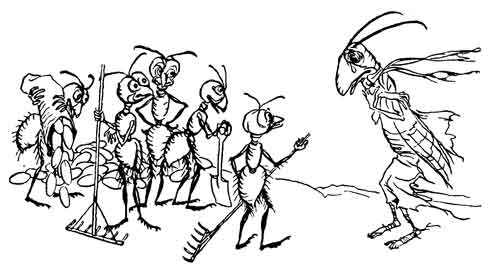
Χειμῶνος ὥραι, τῶν σίτων βραχέντων, οἱ μύρμηκες ἔψυχον, τέττιξ δὲ λιμώττων ἤιτει αὐτοὺς τροφήν. Οἱ δὲ μύρμηκες εἶπον αὐτῷ· Διὰ τί τὸ θέρος οὐ συνῆγες τροφήν; Ὁ δὲ εἶπεν· Οὐκ ἐσχόλαζον, ἀλλ᾿ ᾖδον μουσικῶς. Οἱ δὲ γελάσαντες εἶπον· Ἀλλ᾿ εἰ θέρους ὥραις ηὔλεις, χειμῶνος ὀρχοῦ.

Χειμῶνος ὥραι, 
τῶν σίτων βραχέντων, 
οἱ μύρμηκες ἔψυχον, 
τέττιξ δὲ λιμώττων 
ἤιτει αὐτοὺς τροφήν. 
Οἱ δὲ μύρμηκες εἶπον αὐτῷ· 
Διὰ τί τὸ θέρος 
οὐ συνῆγες τροφήν; 
Ὁ δὲ εἶπεν· 
Οὐκ ἐσχόλαζον, 
ἀλλ᾿ ᾖδον μουσικῶς. 
Οἱ δὲ γελάσαντες εἶπον· 
Ἀλλ᾿ εἰ θέρους ὥραις ηὔλεις, 
χειμῶνος ὀρχοῦ.

Χειμῶνος ὥραι  ...  During winter time,
τῶν σίτων βραχέντων  ...  when food ran short, 
οἱ μύρμηκες ἔψυχον  ...  the ants were drying (their food). 
τέττιξ δὲ λιμώττων  ...  The grasshopper was starving
ἤιτει αὐτοὺς τροφήν  ...  and asked them for food. 
Οἱ δὲ μύρμηκες εἶπον αὐτῷ  ...  The ants asked him, 
Διὰ τί τὸ θέρος  ...  Why, during the summer, 
οὐ συνῆγες τροφήν  ...  did you not gather food? 
Ὁ δὲ εἶπεν  ...  The grasshopper said, 
Οὐκ ἐσχόλαζον  ...  I was not lazy! 
ἀλλ᾿ ᾖδον μουσικῶς  ...  I made my music.
Οἱ δὲ γελάσαντες εἶπον  ...  The ants laughed and said,
Ἀλλ᾿ εἰ ηὔλεις  ...  If you serenaded 
θέρους ὥραις  ...  during the summertime,
χειμῶνος ὀρχοῦ  ...  now dance for the winter!


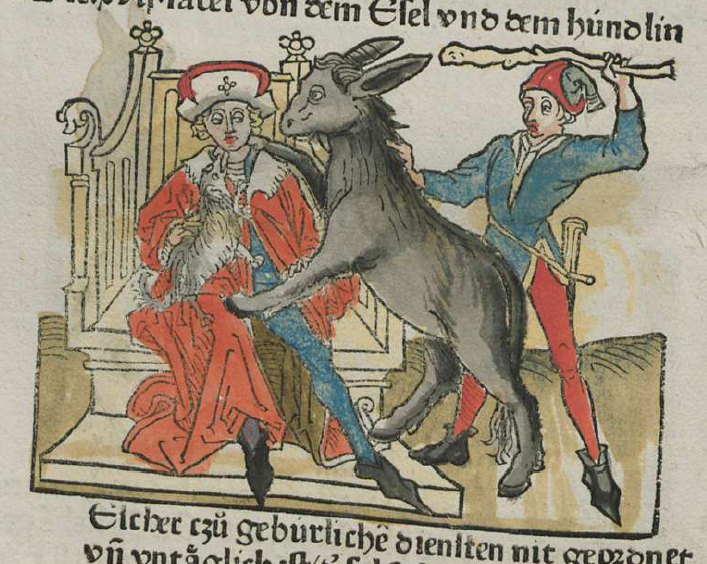
Ἔχων τις κύνα Μελιταῖον καὶ ὄνον, διετέλει τῷ κυνὶ προσπαίζων· καὶ εἴ ποτε ἔξω δεῖπνον εἶχεν, εκόμιζέ τι αὐτῷ, καὶ προσιόντι παρέβαλεν· ὁ δὲ ὄνος ζηλώσας προσέδραμεν αὐτός, καὶ σκιρτῶν ἐλάκτισε τὸν δεσπότην. Καὶ οὗτος ἀγανακτήσας ἐκέλευσε παίοντα αὐτὸν ἀπαγαγεῖν πρὸς τὸν μυλῶνα, καὶ τοῦτον δῆσαι.

Ἔχων τις κύνα Μελιταῖον  ...  A man had a Maltese dog 
καὶ ὄνον  ...  and a donkey.
διετέλει προσπαίζων  ...  He constantly played
τῷ κυνὶ  ... with the dog,
καὶ εἴ ποτε  ...  and whenever
ἔξω δεῖπνον εἶχεν  ...  he had dinner out, 
εκόμιζέ τι αὐτῷ  ...  he brought the dog something, 
καὶ παρέβαλεν  ...  and tossed it to him
προσιόντι  ...  when he came up to him.
ὁ δὲ ὄνος ζηλώσας  ...  The donkey was jealous 
προσέδραμεν αὐτός  ...  so he also ran up, 
καὶ σκιρτῶν  ...  and leaped 
ἐλάκτισε τὸν δεσπότην  ...  putting his feet on him. 
Καὶ οὗτος ἀγανακτήσας  ...  The man was angry 
ἐκέλευσε  ...  and ordered  
παίοντα αὐτὸν  ... that the donkey be beaten
ἀπαγαγεῖν  ...  and led away 
πρὸς τὸν μυλῶνα  ...  to the mill-house 
καὶ τοῦτον δῆσαι  ...  and to tie him up there.


Σιδώνιος σχολαστικὸς ἀπὸ πολλῶν μιλίων χωρίον ἔχων καὶ θέλων αὐτὸ ἐγγύτερον ποιῆσαι, ἑπτὰ κίονας μιλίων κατέστρεψεν.

Σιδώνιος σχολαστικὸς 
ἀπὸ πολλῶν μιλίων χωρίον ἔχων 
καὶ θέλων αὐτὸ ἐγγύτερον ποιῆσαι, 
ἑπτὰ κίονας μιλίων κατέστρεψεν.

Σιδώνιος σχολαστικὸς  ...  A Sidonian dunce
χωρίον ἔχων  ...  owned a piece of land 
ἀπὸ πολλῶν μιλίων  ...  many miles away, 
καὶ θέλων  ...  and he wanted 
αὐτὸ ἐγγύτερον ποιῆσαι  ...  to make it closer, 
κατέστρεψεν  ...  so he knocked down
ἑπτὰ κίονας μιλίων  ...  seven mile-markers.

And here's a random proverb and a random LOLCat too:


Click here to subscribe/unsubscribe to the email list.


Wednesday, June 11, 2025

Greek Vocabulary Challenge: June 12

Here are today's vocabulary words; it's Group 173. Click on the word to learn more at Logeion:

ἐν (prep.+dat.): in, at 
οὐκέτι (adverb): no longer, no more 
ἑαυτοῦ (pronoun): -self 
δέ (particle): indicates a transition or explanation 
πέλας (adverb): near, neighboring 

These are the proverbs (and there are always more proverbs at the blog):

Ἀετὸς ἐν νεφέλαις.

Ἐπεὶ οὐκέτι πιστὰ γυναιξίν.

Τὶ δύσκολον; Τὸ ἑαυτὸν γνῶναι.

Πάντες δὲ θεῶν χατέουσ' ἄνθρωποι.

Ὁ συκοφάντης ἐστὶ τοῖς πέλας λύκος.

And now, some commentary:

Ἀετὸς ἐν νεφέλαις.
An eagle in the clouds.
This saying can be applied to several different situations: to something lofty and great, especially if it excels others, and also to something that is difficult or even impossible to obtain. You can see Erasmus's Adagia for a variety of Greek citations.

Ἐπεὶ οὐκέτι πιστὰ γυναιξίν.
No longer can trust (be placed) in women.
The words are from Homer's Odyssey. The context is Odysseus's journey to the underworld and his conversation with the ghost of Agamemnon. Given how his own wife plotted against him, it's not surprising that Agamemnon would express this low opinion of women.

Τὶ δύσκολον; Τὸ ἑαυτὸν γνῶναι.
What is difficult? To know oneself.
The saying is attributed to Thales by Diogenes Laertius, and it is part of a series of question-and-answer statements by Thales. For example, the next question is τί δὲ εὔκολον; τὸ ἄλλῳ ὑποθέσθαι: "what is easy? to give advice to another."

Πάντες δὲ θεῶν χατέουσ' ἄνθρωποι.
All humans have need of gods.
This is also from the Odyssey; the context this time is Nestor's son welcoming strangers (Telemachus and Athena/Mentor) to the feast of Poseidon, urging them to drink in honor of the gods.

Ὁ συκοφάντης ἐστὶ τοῖς πέλας λύκος.
The informer is a wolf to his neighbors.
The phrase τοῖς πέλας means, literally, "those nearby," i.e. "neighbors." The saying is from the monostichs (one-liners) of Menander, and there is also a variant version: Ὁ συκοφάντης ἐστὶν ἐν πόλει λύκος, "The informer is a wolf in the city."
Both scan as iambic verse:
Ὁ συκοφάν||της ἐστὶ τοῖς || πέλας λύκος.
Ὁ συκοφάν||της ἐστὶν ἐν || πόλει λύκος


And here's a random proverb and a random LOLCat too:


Click here to subscribe/unsubscribe to the email list.


Tuesday, June 10, 2025

Greek Reading: 70

The fables below come from Bryce's First Greek Reader, while the joke comes from Abbott's Easy Greek Reader, both of which are available at the Internet Archive. 

You'll find the fables and joke below, first in Greek, then segmented, and then interwoven with English. The titles are linked to the Internet Archive page.


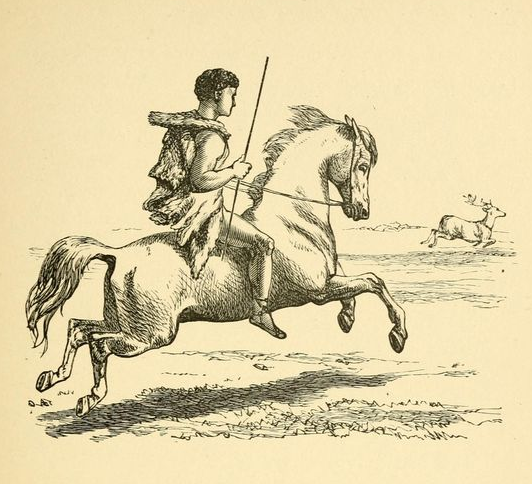
Ἵππος κατεῖχε λειμῶνα μόνος, ἐλθόντος δ᾽ ἐλάφου καὶ διαφθείροντος τὴν νομὴν βουλόμενος τιμωρήσασθαι τὸν ἔλαφον ἠρώτα τιν' ἄνθρωπον εἰ δύναιτο μετ᾽ αὐτοῦ κολάσαι τὸν ἔλαφον, ὁ δ᾽ ἔφησεν, ἐὰν λάβῃ χαλινὸν καὶ αὐτὸς ἀναβῇ ἐπ᾽ αὐτὸν ἔχων ἀκόντια: συνομολογήσαντος δὲ καὶ ἀναβάντος ἀντὶ τοῦ τιμωρήσασθαι αὐτὸς ἐδούλευσεν ἤδη τῷ ἀνθρώπῳ. 

Ἵππος κατεῖχε λειμῶνα μόνος, 
ἐλθόντος δ᾽ ἐλάφου 
καὶ διαφθείροντος τὴν νομὴν 
βουλόμενος τιμωρήσασθαι τὸν ἔλαφον 
ἠρώτα τιν' ἄνθρωπον 
εἰ δύναιτο μετ᾽ αὐτοῦ κολάσαι τὸν ἔλαφον, 
ὁ δ᾽ ἔφησεν, 
ἐὰν λάβῃ χαλινὸν 
καὶ αὐτὸς ἀναβῇ ἐπ᾽ αὐτὸν 
ἔχων ἀκόντια: 
συνομολογήσαντος δὲ 
καὶ ἀναβάντος ἀντὶ τοῦ τιμωρήσασθαι 
αὐτὸς ἐδούλευσεν ἤδη τῷ ἀνθρώπῳ. 

Ἵππος κατεῖχε  ...  A horse was master
λειμῶνα μόνος  ...  of a meadow all to himself
ἐλθόντος δ᾽ ἐλάφου  ...  but when a deer came 
καὶ διαφθείροντος τὴν νομὴν  ...  and wrecked the pasture 
βουλόμενος  ...  the horse wanted 
τιμωρήσασθαι τὸν ἔλαφον  ...  to get revenge on the deer 
ἠρώτα τιν' ἄνθρωπον  ...  and he asked a human being 
εἰ μετ᾽ αὐτοῦ δύναιτο  ...  if with him he could
κολάσαι τὸν ἔλαφον  ...  punish the deer,
ὁ δ᾽ ἔφησεν  ...  the man said 
ἐὰν λάβῃ χαλινὸν  ...  if the horse would accept a bridle 
καὶ αὐτὸς ἀναβῇ ἐπ᾽ αὐτὸν  ...  and let the man mount him 
ἔχων ἀκόντια  ...  while wielding his javelin: 
συνομολογήσαντος δὲ  ...  and when the horse agreed
καὶ ἀναβάντος  ...  and the man mounted him
ἀντὶ τοῦ τιμωρήσασθαι  ...  instead of getting revenge 
αὐτὸς ἐδούλευσεν ἤδη  ...  the horse was then a slave 
τῷ ἀνθρώπῳ  ...  to the man. 


Γεωργοῦ παῖς ὤπτα κοχλίας· ἀκούσας δὲ αὐτῶν τρυζόντων, ἔφη, Ὦ κάκιστα ζῶα, τῶν οἰκιῶν ὑμῶν ἐμπιπραμένων, αὐτοὶ ᾄδετε;

Γεωργοῦ παῖς 
ὤπτα κοχλίας· 
ἀκούσας δὲ αὐτῶν 
τρυζόντων, 
ἔφη, 
Ὦ κάκιστα ζῶα, 
τῶν οἰκιῶν ὑμῶν ἐμπιπραμένων, 
αὐτοὶ ᾄδετε;

Γεωργοῦ παῖς  ...  A farmer's child
ὤπτα κοχλίας  ...  was roasting snails,
ἀκούσας δὲ αὐτῶν  ...  and when he heard them 
τρυζόντων  ...  sizzling, 
ἔφη  ...  he said, 
Ὦ κάκιστα ζῶα  ...  O wretched creatures, 
τῶν οἰκιῶν ὑμῶν ἐμπιπραμένων  ...  your homes are on fire,  
αὐτοὶ ᾄδετε  ...  and you're singing?


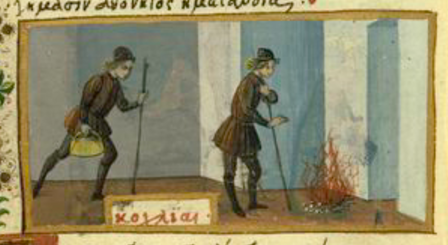
Δυσκόλῳ ἰατρῷ προσελθών τις εἶπε· σοφιστὰ, ἀνακεῖσθαι οὐ δύναμαι, οὐδὲ ἑστάναι, ἀλλ' οὐδὲ καθῆσθαι. καὶ ὁ ἰατρὸς εἶπεν, οὐδὲν σοι λείπει ἢ κρεμασθῆναι.

Δυσκόλῳ ἰατρῷ 
προσελθών τις εἶπε· 
σοφιστὰ, 
ἀνακεῖσθαι οὐ δύναμαι, 
οὐδὲ ἑστάναι, 
ἀλλ' οὐδὲ καθῆσθαι. 
καὶ ὁ ἰατρὸς εἶπεν, 
οὐδὲν σοι λείπει 
ἢ κρεμασθῆναι.

προσελθών τις  ...  Someone went
δυσκόλῳ ἰατρῷ  ...  to a grumpy physician
εἶπε  ...  and said,
σοφιστὰ  ...  Doctor, 
ἀνακεῖσθαι οὐ δύναμαι  ...  I can't lie down, 
οὐδὲ ἑστάναι  ...  and I can't stand,
ἀλλ' οὐδὲ καθῆσθαι  ...  and I can't sit either.
καὶ ὁ ἰατρὸς εἶπεν  ...  And the physician said, 
οὐδὲν σοι λείπει  ...  Nothing left to do then
ἢ κρεμασθῆναι  ...  except hang yourself.


And here's a random proverb and a random LOLCat too:


Click here to subscribe/unsubscribe to the email list.


Monday, June 9, 2025

Greek Vocabulary Challenge: June 10

Here are today's vocabulary words; it's Group 172. These are sayings you've seen before, but with a new word focus. Click on the word to learn more at Logeion:

ψέγω ~ ψέξω ~ ἔψεξα (verb): blame, find fault 
φθονέω ~ φθονήσομαι ~ ἐφθόνησα (verb): envy, be jealous 
ἐργάζομαι ~ ἐργάσομαι ~ εἰργασάμην (verb): work at, make 
πρέπω ~ πρέψω ~ πρέψω (verb): be fitting, appropriate 
ψεύδω ~ ψεύσω ~ ἔψευσα (verb): lie, falsify 

These are the proverbs (and there are always more proverbs at the blog):

Ψέγε μηδένα.

Φθόνει μηδενί.

Τὰ δειλὰ κέρδη πημονὰς ἐργάζεται.

Σιγᾶν ἄμεινον ἢ λαλεῖν ἃ μὴ πρέπει.

Πολλ' ἐλπίδες ψεύδουσι καὶ λόγοι βροτούς.


And now, some commentary:

Ψέγε μηδένα.
Blame no one.
This is one of the so-called Delphic maxims attributed to the Seven Sages by Stobaeus. The word μηδείς is a compound of μη and εἷς, no-one, parallel to οὐδείς. The οὐ form is used for indicative statements, while the μη form is used for imperatives (as here: ψέγε), subjunctives, etc.

Φθόνει μηδενί.
Envy no one.
Note again the use of μηδείς with the imperative φθόνει, corresponding to the use of οὐδείς in the indicative. The verb φθονέω takes a dative complement, μηδενί. This is another one of the Delphic maxims.

Τὰ δειλὰ κέρδη πημονὰς ἐργάζεται.
Vile profits cause calamities. 
The words come from Sophocles' Antigone, at the end of Creon's tirade against the evils of money. Although Greek κέρδος came to mean "profit" or "gain," it originally meant "craft" or "skill" and it continued to have the meaning of "craftiness," especially in the negative sense of "wiles" or "mischief." See Logeion for more details.

Σιγᾶν ἄμεινον ἢ λαλεῖν ἃ μὴ πρέπει.
To be silent is better than to say things that are not appropriate.
The Greek infinitive, σιγᾶν, is a neuter noun, hence the neuter adjective, ἄμεινον (the masculine form is ἀμείνων). This is  one of Menander's monostichs; here is the iambic meter marked:
Σιγᾶν ἄμει||νον ἢ λαλεῖν || ἃ μὴ πρέπει.

Πολλ' ἐλπίδες ψεύδουσι καὶ λόγοι βροτούς.
Hopes and words deceive mortal men in many ways.
The word πολλ' is πολλά, with the final vowel falling out before the following vowel (apocope).
This is a fragment from Euripides' Protesilaus. The meter is iambic:
Πολλ' ἐλ~πίδες || ψεύδου~σι καὶ || λόγοι ~ βροτούς.


And here's a random proverb and a random LOLCat too:


Click here to subscribe/unsubscribe to the email list.


Greek Reading: 69

The fables below come from Bryce's First Greek Reader, while the joke comes from Abbott's Easy Greek Reader, both of which are available at the Internet Archive. 

You'll find the fables and joke below, first in Greek, then segmented, and then interwoven with English. The titles are linked to the Internet Archive page.


Ὄρνις ὄφεως ὠὰ εὑροῦσα ἐπιμελῶς ἐκθερμάνασα ἐξεκόλαψε. Χελιδὼν δὲ θεασαμένη αὐτὴν ἔφη· ὦ ματαία, τί ταῦτα τρέφεις, ἅπερ αὐξηθέντα ἀπὸ σοῦ πρώτης τοῦ ἀδικεῖν ἄρξεται;

Ὄρνις 
ὄφεως ὠὰ εὑροῦσα 
ἐπιμελῶς ἐκθερμάνασα 
ἐξεκόλαψε. 
Χελιδὼν δὲ 
θεασαμένη αὐτὴν ἔφη· 
ὦ ματαία, 
τί ταῦτα τρέφεις, 
ἅπερ αὐξηθέντα 
ἀπὸ σοῦ πρώτης 
τοῦ ἀδικεῖν ἄρξεται;

Ὄρνις  ...  A chicken
ὄφεως ὠὰ εὑροῦσα  ...  found some snake eggs
ἐπιμελῶς ἐκθερμάνασα  ...  and decided to warm them 
ἐξεκόλαψε  ...  and hatch them. 
Χελιδὼν δὲ  ...  A swallow 
θεασαμένη αὐτὴν ἔφη  ...  saw her and said, 
ὦ ματαία  ...  You fool! 
τί ταῦτα τρέφεις  ...  Why are you nourishing creatures  
ἅπερ αὐξηθέντα  ...  who as soon as they are grown
τοῦ ἀδικεῖν ἄρξεται  ...  will start doing harm
ἀπὸ σοῦ πρώτης  ...  beginning with you!


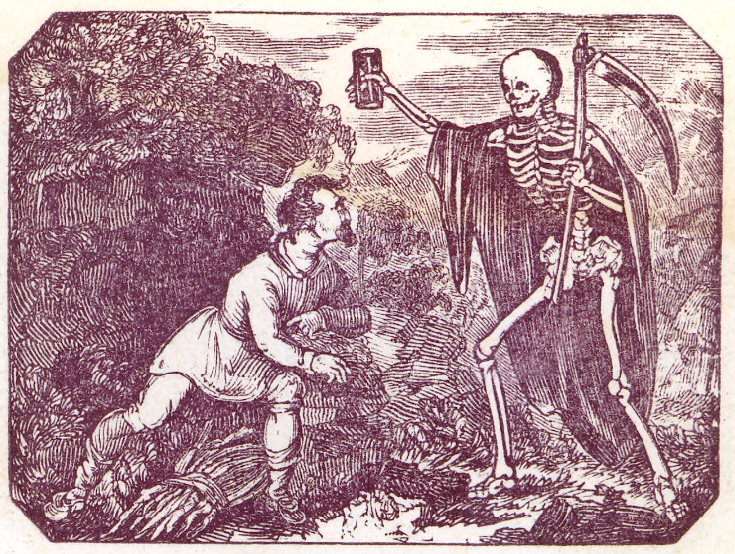
Γέρων ποτὲ ξύλα τεμὼν ἐξ ὄρους κἀπὶ τῶν ὤμων ἀράμενος, ἐπειδὴ πολλὴν ὁδὸν ἐπηχθισμένος ἐβάδισεν, ἀπειρηκὼς ἀπέθετό τε τὰ ξύλα, καὶ τὸν θάνατον ἐλθεῖν ἐπεκαλεῖτο. Τοῦ δὲ θανάτου εὐθὺς ἐπιστάντος, καὶ τὴν αἰτίαν πυνθανομένου, δ᾿ ἣν αὐτὸν καλοίη, ὁ γέρων ἔφη· ἵνα τὸν φόρτον τοῦτον ἄρας ἐπιθῇς μοι.

Γέρων ποτὲ 
ξύλα τεμὼν ἐξ ὄρους 
κἀπὶ τῶν ὤμων ἀράμενος, 
ἐπειδὴ πολλὴν ὁδὸν 
ἐπηχθισμένος ἐβάδισεν, 
ἀπειρηκὼς ἀπέθετό τε τὰ ξύλα, 
καὶ τὸν θάνατον ἐλθεῖν ἐπεκαλεῖτο. 
Τοῦ δὲ θανάτου εὐθὺς ἐπιστάντος, 
καὶ τὴν αἰτίαν πυνθανομένου, 
δ᾿ ἣν αὐτὸν καλοίη, 
ὁ γέρων ἔφη· 
ἵνα τὸν φόρτον τοῦτον ἄρας 
ἐπιθῇς μοι.

Γέρων ποτὲ  ...  There was once an old man
ξύλα τεμὼν  ...  who had cut wood  
ἐξ ὄρους  ...  from up on the mountain
καὶ ἀράμενος  ...  and was carrying the wood 
ἐπὶ τῶν ὤμων  ... upon his shoulders
ἐπειδὴ ἐβάδισεν  ...  and when he'd walked
πολλὴν ὁδὸν  ...  a long way
ἐπηχθισμένος  ...  burdened with the wood,
ἀπειρηκὼς  ...  he gave up,  
ἀπέθετό τε τὰ ξύλα  ...  and put the wood down, 
καὶ ἐπεκαλεῖτο  ...  and called out, 
τὸν θάνατον ἐλθεῖν  ...  for Death to come. 
εὐθὺς  ...  All of a sudden
τοῦ δὲ θανάτου ἐπιστάντος  ...  Death stood there 
καὶ πυνθανομένου  ...  and asked
τὴν αἰτίαν  ...  the reason why
δ᾿ ἣν αὐτὸν καλοίη  ...  he had summoned him. 
ὁ γέρων ἔφη  ...  The old man said, 
ἵνα τὸν φόρτον τοῦτον ἄρας ...  To lift up this burden 
ἐπιθῇς μοι  ...  and put it back on my shoulders.


Ἀβδηρίτου στρουθίον ἀπέθανε. μετὰ οὖν χρόνον ἰδὼν στρουθοκάμηλον, εἶπεν, εἰ ἔζη τὸ στρουθίον μου, ἤδη ἂν τηλικοῦτον ὑπῆρχεν.

Ἀβδηρίτου στρουθίον 
ἀπέθανε. 
μετὰ οὖν χρόνον 
ἰδὼν στρουθοκάμηλον, 
εἶπεν, 
εἰ ἔζη τὸ στρουθίον μου, 
ἤδη ἂν τηλικοῦτον ὑπῆρχεν.

Ἀβδηρίτου στρουθίον  ...  A dunce's pet sparrow
ἀπέθανε  ...  died.
μετὰ οὖν χρόνον  ...  After a while 
ἰδὼν στρουθοκάμηλον  ...  he saw an ostrich, 
εἶπεν  ...  and said:
εἰ ἔζη τὸ στρουθίον μου  ...  If my sparrow had lived, 
ἤδη ἂν τηλικοῦτον ὑπῆρχεν  ...  he would be that size now!

(The word for ostrich in Greek is στρουθοκάμηλος, sparrow-camel.)


And here's a random proverb and a random LOLCat too:


Click here to subscribe/unsubscribe to the email list.