Showing posts with label Week 009. Show all posts

Friday, May 31, 2024

Week 9: Proverb and Vocabulary Review

I've now added audio to all the posts for the past week; see playlist below, and the audio is also embedded in each post!

Last week I posted some Quia activities for reviewing the eighth week of proverbs and vocabulary, plus noun and verb forms review; see the first week's review post for an explanation of how to use Quia activities, and you can find all my Quia materials here.

This week, I created the same activities for the Week 9 proverbs: ProverbsVocabularyVocabulary with Parts, plus Verb Practice and Noun Practice.

Here's the updated widget showing a random proverb, and I've also updated the alphabetical index of all the proverbs so far (270!).


If you want to review this week's posts, here they are: #49 - #50 - #51 - #52 - #53 - #54. You can also listen to the audio for each group at SoundCloud (I'm still working on filling in the audio for the earlier weeks):


Finally, here is the list of all of this week's proverbs, alphabetized and linked back to the blog post so that you can access the English translation and commentary as needed. Enjoy!

Thursday, May 30, 2024

54: ask, convey, frighten, fear, fall in

Here are today's vocabulary words; they are verbs with present, future, and aorist stems, plus a brief definition. (If you are just beginning Greek and have not studied the future or aorist stems yet, you can just focus on the present stem.) Click on the word to learn more at Logeion, and there's also a study tips post.

1. αἰτέω ~ αἰτήσω ~ ᾔτησα: ask, beg 
2. κομίζω ~ κομιέω ~ ἐκόμισα: convey, carry 
3. φοβέω ~ φοβήσω ~ ἐφόβησα: frighten, terrify 
4. δείδω ~ δείσω ~ ἔδεισα: fear 
5. ἐμπίπτω ~ ἐμπεσέομαι ~ ἐνέπεσον: fall in, fall upon 

Here are the proverbs and sayings:

Παντὶ αἰτοῦντί σε δίδου.

Κορώνη γράμμα κομίζει.

Μὴ φοβοῦ, μόνον πίστευε.

Τὴν αὑτοῦ σκιὰν δέδοικεν.

Ὁ ὀρύσσων βόθρον ἐν αὐτῷ ἐμπεσεῖται.


Plus some commentary:

Παντὶ αἰτοῦντί σε δίδου.
Give to each person who asks you.
The words come from the Gospel of Luke, and you can find out more at Wikipedia: Sermon on the Plain (not the same as Sermon on the Mount in Matthew).

Κορώνη γράμμα κομίζει.
The crow carries the letter.
This proverbial saying referred to messengers who delivered news promptly. Aelian reports the legend of a certain king of Egypt who had a tame crow that was swifter than any human messenger; as soon as you told the crow where to go, it immediately understood and flew off carrying the letter. When the crow died, the king honored it with a tomb at Crocodopolis.

Μὴ φοβοῦ, μόνον πίστευε.
Do not be afraid; just have faith.
The words are spoken to Jairus by Jesus in the Gospel of Mark when he is told that the daughter of Jairus is dead; he then goes and revives her. You can find out more at Wikipedia: Raising of Jairus's Daughter. From the Greek root φοβ- we get all the -phobia words in English. The word μόνον is used adverbially here; the neuter singular is often used as an adverb.

Τὴν αὑτοῦ σκιὰν δέδοικεν.
He fears his own shadow.
The words are from a fragment of Aristophanes, and of course we use the same phrase in English, "to be afraid of your own shadow." Erasmus cites the phrase with a different verb: Τὴν αὑτοῦ σκιὰν φοβεῖσθαι (φοβέω is also one of today's verbs). Plato uses the phrase in the Phaedo, where he labels it as a saying: τὸ λεγόμενον.

Ὁ ὀρύσσων βόθρον ἐν αὐτῷ ἐμπεσεῖται.
The one digging a hole will fall into it.
The saying comes from the Biblical Book of Ecclesiastes, referring to the notion that someone who plots against another will himself turn out to be the victim. Compare a more literal version of the same idea from Hesiod that you saw earlier this week: Οἷ γ᾽ αὐτῷ κακὰ τεύχει ἀνὴρ ἄλλῳ κακὰ τεύχων, "The man working evil against another works evil against himself."


Here is William Blake's depiction of the raising of Jairus's daughter:


Wednesday, May 29, 2024

53: sacrifice, word, wine, mistress, wickedness

Here are today's vocabulary words; they are nouns shown in the nominative and genitive plus gender, along with a brief definition. Click on the word to learn more at Logeion, and there's also a study tips post.

1. θυσία ~ θυσίας (fem.): sacrifice, victim 
2. ἔπος ~ ἔπους (neut.): word, poetry 
3. οἶνος ~ οἴνου (masc.): wine 
4. δέσποινα ~ δεσποίνης (fem.): mistress, lady of the house 
5. πονηρία ~ πονηρίας (fem.): wickedness, viciousness

Here are the proverbs and sayings:

Ἀγαμέμνονος θυσία.

Ἅμ᾽ ἔπος, ἅμ᾽ ἔργον.

Οἶνον νέον εἰς ἀσκοὺς καινούς.

Τὰς δεσποίνας αἱ κύνες μιμούμεναι.

Προφάσεως δεῖται μόνον ἡ πονηρία. 

Plus some commentary:

Ἀγαμέμνονος θυσία.
The sacrifice of Agamemnon.
As Erasmus tells us, the saying applies to someone who is reluctant or uncooperative. One explanation is that the saying alludes to the time when Agamemnon was sacrificing a bull which fled from the sacrifice and had to be captured and dragged back to the altar. Another explanation is that it refers to Agamemnon having to sacrifice his own daughter, Iphigenia, which he was reluctant to do. You can read more about that at Wikipedia: Iphigenia.

Ἅμ᾽ ἔπος, ἅμ᾽ ἔργον.
The deed at the same time as the word.
Compare the English saying, "No sooner said than done." The Greek ἁμα can be used in tandem as here, ἅμα...ἅμα, and it can also be used with τε...καί as in this variation on the same idea: ἅμα ἔπος τε καὶ ἔργον, "at the same time both the word and the deed." From the root in Greek ἔπος we get English "epic."

Οἶνον νέον εἰς ἀσκοὺς καινούς.
New wine (goes) into new wineskins.
The words are from the Gospel of Mark, and the parable is found in all three synoptic gospels. You can find out more at Wikipedia: New Wine into Old Wineskins. The idea is about how innovation requires the right context: if new wine is put into old wineskins, the skins will burst because old wineskins are already stretched and have become brittle; the new wine needs to go into new wineskins that can expand as the wine matures. From Greek οἶνος we get the English word oenology, the study of wine. The Greek word is from the Indo-European root wéyh₁ō, as is English "wine" and Latin vinum.

Τὰς δεσποίνας αἱ κύνες μιμούμεναι.
Dogs imitating their owners.
Specifically, female dogs, αἱ κύνες, imitating their female owners, δεσποίνας. As Erasmus explains, the  saying was used to refer to slaves or students or other subordinates who act like their masters, teachers, etc.: bad-tempered if their masters are bad-tempered, arrogant if their teachers are arrogant, etc. Plato invokes this saying in The Republic, where he labels it as a proverb: κατὰ τὴν παροιμίαν, "according to the proverb."

Προφάσεως δεῖται μόνον ἡ πονηρία.
Viciousness needs only a pretext.
The words are from Aristotle's Rhetoric, and he goes on to list all the many sorts of excuses people might use to justify their attacks on others, including the deeds of their ancestors or allies, etc. Aristotle identifies the words as a proverb: ὥσπερ γὰρ ἡ παροιμία, "as the proverb (says)." Note that the verb δεῖται takes a genitive complement: προφάσεως, "needs a pretext = has need of a pretext." 


Here is a fresco from Pompeii showing the sacrifice of Iphigenia:

Tuesday, May 28, 2024

52: be in, withdraw, forgive, go, make

Here are today's vocabulary words; they are verbs with present, future, and aorist stems, plus a brief definition. (If you are just beginning Greek and have not studied the future or aorist stems yet, you can just focus on the present stem.) Click on the word to learn more at Logeion, and there's also a study tips post.

1. ἔνειμι ~ ἐνέσομαι (no aorist): be in, be present 
2. ὑπάγω ~ ὑπάξω ~ ὑπήγαγον: go, go away, withdraw 
3. ἀπολύω ~ ἀπολύσω ~ ἀπέλυσα: release, set free, forgive
4. πορεύω ~ πορεύσομαι ~ ἐπορευσάμην: carry; go, go away
5. τεύχω ~ τεύξω ~ ἔτευξα: make, build 

Here are the proverbs and sayings:

Ἔνεστι κἀν μύρμηκι χολή.

Ὕπαγε ὀπίσω μου, Σατανᾶ.

Ἀπολύετε, καὶ ἀπολυθήσεσθε.

Γενεὰ πορεύεται καὶ γενεὰ ἔρχεται.

Οἷ γ᾽ αὐτῷ κακὰ τεύχει ἀνὴρ ἄλλῳ κακὰ τεύχων. 

Plus some commentary:

Ἔνεστι κἀν μύρμηκι χολή.
There is bile even in the ant.
In other words, even though it is tiny, the ant has a temper! As Erasmus explains, the proverb warns that even a "small" enemy can be dangerous. The word κἀν is a contraction: καὶ ἐν (the breathing mark inside the word is a clue to the contraction). The bile, χολή, was one of the four humors of the body in Greek medicine: blood, phlegm, black bile, and yellow bile. The yellow bile was associated with anger, hence the English word choleric. You can find out more at Wikipedia: Four temperaments. The black bile, µέλαινα χολή, gave rise to melancholy.

Ὕπαγε ὀπίσω μου, Σατανᾶ.
Get behind me, Satan.
The words are from the Gospel of Mark, when Jesus rebukes Peter, a scene that is repeated in the Gospel of Matthew. The phrase later became part of the Catholic ritual of exorcism; see Wikipedia: Get Behind Me, Satan and also Wikipedia; Vade Retro, Satana.

Ἀπολύετε, καὶ ἀπολυθήσεσθε.
Forgive, and you will be forgiven.
The words are from the Gospel of Luke.
The complete verse has three parallel statements: καὶ μὴ κρίνετε, καὶ οὐ μὴ κριθῆτε· καὶ μὴ καταδικάζετε, καὶ οὐ μὴ καταδικασθῆτε. ἀπολύετε, καὶ ἀπολυθήσεσθε, "Do not judge, and you will not be judge; do not not condemn, and you will not be condemned; forgive, and you will be forgiven."

Γενεὰ πορεύεται καὶ γενεὰ ἔρχεται.
A generation goes and a generation comes.
The words are from the Biblical Book of Ecclesiastes. The complete verse reads: γενεὰ πορεύεται καὶ γενεὰ ἔρχεται καὶ ἡ γῆ εἰς τὸν αἰῶνα ἕστηκεν, "and the earth abides forever." The Greek word γενεά is from the Indo-European root, *ǵenh₁, "produce, give birth," thus related to English "kin."

Οἷ γ᾽ αὐτῷ κακὰ τεύχει ἀνὴρ ἄλλῳ κακὰ τεύχων.
The man working evil against another works evil against himself.
The words are from Hesiod's Works and Days. Hesiod goes on to say in the next line: ἡ δὲ κακὴ βουλὴ τῷ βουλεύσαντι κακίστη, "the evil plan is most evil for the planner." Hesiod's poem is in dactylic hexameter; I've used dashes here to separate the feet:
Οἷ γ᾽ αὐ-τῷ κακὰ - τεύχει ἀ-νὴρ ἄλ-λῳ κακὰ - τεύχων
[note the long vowel before hiatus in this dactyl: ...τεύχει ἀ...]


Here is Tissot's painting of Jesus rebuking Peter:


Monday, May 27, 2024

51: knee, image, sign, mountain, reward

Here are today's vocabulary words; they are nouns shown here in the nominative and genitive plus gender, along with a brief definition. Click on the word to learn more at Logeion, and there's also a study tips post.

1. γόνυ ~ γόνατος (neut.): knee
2. εἰκών ~ εἰκόνος (fem.): image, likeness
3. σημεῖον ~ σημείου (neut.): sign, omen
4. ὄρος ~ ὄρεος (neut.): mountain, hill
5. μισθός ~ μισθοῦ (masc.): wages, reward

Here are the proverbs and sayings:

Γόνυ κνήμης ἔγγιον.

Ψυχῆς εἰκὼν ὁ λόγος ἐστίν.

Τί ἡ γενεὰ αὕτη ζητεῖ σημεῖον;

Ὤδινεν ὄρος, εἶτα μῦν ἀπέτεκεν.

Ὁ μισθὸς ὑμῶν πολὺς ἐν τῷ οὐρανῷ.

Plus some commentary:

Γόνυ κνήμης ἔγγιον.
The knee is closer than the shin.
As Erasmus explains, this saying refers to situations where there is a close allegiance — for example, a cousin — but an allegiance even closer: your brother. Forced to choose, you would choose to help your brother over cousin, just as the knee is closer (to your heart) than your shin. It can also be used to refer to self-interest. The proverbial saying appears in Aristotle and in Athenaeus. Greek γόνυ is cognate with English knee.

Ψυχῆς εἰκὼν ὁ λόγος ἐστίν.
Speech is the image of the soul.
From the Greek word εἰκὼν we get the English word icon. Meanwhile, the range of meaning of Greek λόγος is astounding, and it's always worth reviewing the Logeion entry. Depending on the context, for example, λόγος might also be translated here as "thought" rather than "speech."

Τί ἡ γενεὰ αὕτη ζητεῖ σημεῖον;
Why does this generation seek a sign?
The words are from the Gospel of Matthew, when Jesus rebukes the Pharisees. The Greek word σημεῖον gives us semiotics in English, the study of signs. The Greek word has a wonderful array of meanings as you can see in the Logeion entry, including birthmarks, landmarks, passwords and war-cries. Compare also English semaphore from Greek σῆμα.

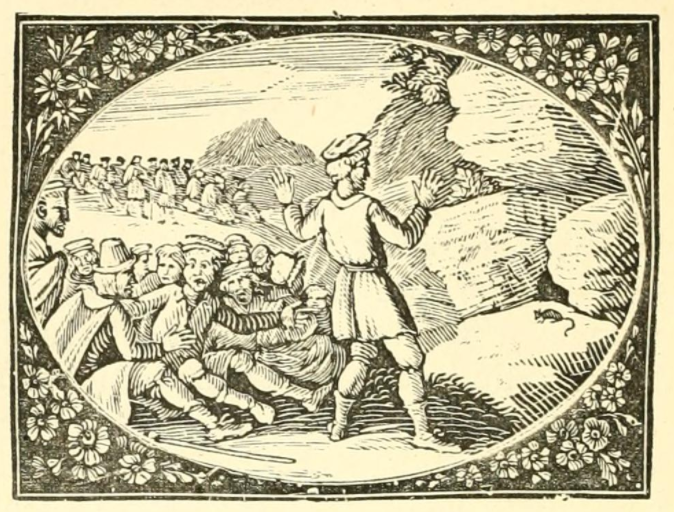
Ὤδινεν ὄρος, εἶτα μῦν ἀπέτεκεν.
The mountain groaned in labor; then it gave birth to a mouse.
This saying became part of the Aesopic tradition: The Mountain in LaborErasmus provides Greek citations, along with the famous instance in Horace: Parturient montes, nascetur ridiculus mus. From Greek ὄρος we get orography in English, the scientific description of mountains.

Ὁ μισθὸς ὑμῶν πολὺς ἐν τῷ οὐρανῷ.
Your reward (will be) great in heaven.
The words come from Jesus in the Gospel of Luke at the end of the Beatitudes; you can find out more about that at Wikipedia: Beatitudes. The version in the Gospel of Matthew uses plural οὐρανοῖς instead: ὁ μισθὸς ὑμῶν πολὺς ἐν τοῖς οὐρανοῖς. For more about the Greek Sky God, Οὐρανός, see Wikipedia: Uranus.


Here is Bewick's illustration of the Aesopic fable about the mountain giving birth to a mouse:


Sunday, May 26, 2024

50: afraid, rich, alone, treasure, neighbor

Here are today's vocabulary words; they are masculine nouns and adjectives, shown in the nominative and genitive, along with a brief definition. Click on the word to learn more at Logeion, and there's also a study tips post.

1. δειλός ~ δειλοῦ (adj. masc.): cowardly, afraid 
2. πλούσιος ~ πλουσίου (adj. masc.): wealthy, rich 
3. μόνος ~ μόνου (adj. masc.): alone, only 
4. θησαυρός ~ θησαυροῦ (noun masc.): treasure, store 
5. πλησίος ~ πλησίου (adj. masc.): nearby, neighboring 

Here are the proverbs and sayings:

Τί δειλοί ἐστε; Οὔπω ἔχετε πίστιν;

Τοῖς πλουσίοις πολλὰ παραμύθια.

Ἐγὼ γὰρ εἰμὶ τῶν ἐμῶν ἐμὸς μόνος.

Θησαυρός ἐστι τοῦ βίου τὰ πράγματα.

Ἀγαπήσεις τὸν πλησίον σου ὡς σεαυτόν. 


Plus some commentary:

Τί δειλοί ἐστε; Οὔπω ἔχετε πίστιν;
Why are you fearful? Have you no faith at all?
The words are from the Gospel of Mark. When the disciples of Jesus are sailing and a storm blows up, he thus rebukes them and then walks on the water. You can find out more about this Bible story at Wikipedia: Jesus walking on water.

Τοῖς πλουσίοις πολλὰ παραμύθια.
The rich have many consolations.
The words come from Plato's Republic, where it is labeled as proverbial, "they say," φασιν: τοῖς γὰρ πλουσίοις πολλὰ παραμύθιά φασιν εἶναι. The topic under discussion is old age, the idea being that if one has money, old age is not so bad. The adjective πλούσιος is from the noun πλοῦτος, meaning "wealth" or "riches," and as in the name of the god of wealth; find out more at Wikipedia: Plutus. Here the adjective is being used substantively (i.e. as a noun): πλούσιος = rich (man).

Ἐγὼ γὰρ εἰμὶ τῶν ἐμῶν ἐμὸς μόνος.
I alone am mine of mine own.
In other words: I am the only one of my friends that I can truly rely on. The words are preserved in a fragment of the Greek comic writer Apollodorus, clearly imitated in Terence (who brought the style of Greek New Comedy to Roman theater); here is Terence: Nam ego meorum solus sum meus. You can find out more at Wikipedia: Greek New Comedy. From Greek μόνο, we get all the mono- words in English like monopoly, monogamy, etc.

Θησαυρός ἐστι τοῦ βίου τὰ πράγματα.
The treasure of (your) life are (your) deeds.
From Greek θησαυρός we get both treasure and thesaurus in English. This is another of the monostichs of Menander; here is the iambic meter (hyphens and dashes separating the iambic elements):
Θησαυ-ρός ἐσ—τι τοῦ - βίου — τὰ πράγ-ματα.

Ἀγαπήσεις τὸν πλησίον σου ὡς σεαυτόν. 
You shall love your neighbor as yourself.
The words come from the Gospel of Mark, echoing the Book of Leviticus. The commandment to "love thy neighbor" is an example of what is generally called the "golden rule" or the "great commandment," and you can find out more at Wikipedia: Golden Rule. Here the adjective is being used substantively: πλησίος = neighbor(ing).


Here is an illustration of Jesus walking on the water from an Armenian illuminated manuscript:


Saturday, May 25, 2024

49: smallest, impossible, useful, instrument, name

Here are today's vocabulary words; they are neuter nouns and adjectives in the nominative and genitive, along with a brief definition. Click on the word to learn more at Logeion, and there's also a study tips post.

1. ἐλάχιστον ~ ἐλαχίστου (adj. n.): smallest, least 
2. ἀδύνατον ~ ἀδυνάτου (adj. n.): unable, impossible 
3. χρήσιμον ~ χρησίμου (adj. n.): useful 
4. σκεῦος ~ σκεύους (noun n.): utensil, instrument 
5. ὄνομα ~ ὀνόματος (noun n.): name 

Here are the proverbs and sayings:

Τὰ ἐλάχιστα ληπτέον τῶν κακῶν.

Τὸ πεπρωμένον φυγεῖν ἀδύνατον.

Οὐδὲν σιωπῆς ἔστι χρησιμώτερον.

Ἀγαθὴ σοφία ὑπὲρ σκεύη πολέμου.

Λεγιὼν ὄνομά μοι, ὅτι πολλοί ἐσμεν. 

Plus some commentary:

Τὰ ἐλάχιστα ληπτέον τῶν κακῶν.
One should choose the lesser of evils.
The words come from Aristotle; you can find out more at Wikipedia: Lesser of two evils principle. The verbal adjective ληπτέον, meaning something one must take or choose, comes from the verb λαμβάνω; you can read more about this type of verbal adjective here: Greek Gerundive.

Τὸ πεπρωμένον φυγεῖν ἀδύνατον.
It is impossible to escape what is destined.
In Greek, the infinitive — φυγεῖν — is a neuter noun, and so the neuter form of the adjective: ἀδύνατον. Πεπρωμένη — the feminine form of πεπρωμένον — is a goddess associated with the Moirai, Μοῖραι, the Greek goddesses of fate; find out more at Wikipedia: Moirai. The word ἀδύνατον is used as a rhetorical term in English, referring to hyperbole which is so extreme that it is impossible: adynaton.

Οὐδὲν σιωπῆς ἔστι χρησιμώτερον.
Nothing is more useful than silence.
The word χρησιμώτερον is a comparative form of the adjective, χρήσιμος, and so it takes a genitive complement: more useful than silence, σιωπῆς. The adjective comes from the verb χράομαι, "use" (see Logeion for the wide range of meanings of this verb). You can see the Greek root χρη- in the English word, chestromathy, borrowed from Greek χρηστομάθεια. This iambic saying comes from Menander:
Οὐδὲν - σιω—πῆς ἔσ-τι χρη—σιμώ-τερον.

Ἀγαθὴ σοφία ὑπὲρ σκεύη πολέμου.
Wisdom is better than weapons of war.
The words come from the Biblical Book of Ecclesiastes. The use of ὑπὲρ with an adjective to express the comparative form of the adjective is a feature of Septuagint Greek; compare a Biblical proverb you saw in an earlier post: Ὁ κύων ὁ ζῶν αὐτὸς ἀγαθὸς ὑπὲρ τὸν λέοντα τὸν νεκρόν. From Greek πόλεμος, we get the English word polemic. The name Ptolemy is from a variant form of πόλεμος. 

Λεγιὼν ὄνομά μοι, ὅτι πολλοί ἐσμεν.
My name is Legion, because we are many.
The words come from a scene in the Gospel of Mark when Jesus exorcises demons from a man who is possessed by a multitude of demons; this is what the man says when Jesus asks the name of the demon: τί ὄνομά σοι; You can read more at Wikipedia: Legion (demons). This Biblical story is what gives rise to the use of "legion" as an adjective in modern English. From Greek ὄνομά we get English onomatopoeia.


Here is a medieval illustration of Jesus exorcising the demon Legion: