Showing posts with label Week 005. Show all posts

Friday, May 3, 2024

Week 5: Proverb and Vocabulary Review

Last week I posted some Quia activities for reviewing the fourth week of proverbs and vocabulary, plus noun and verb forms review; see the first week's review post for an explanation of how to use Quia activities, and you can find all my Quia materials here.

This week, I created the same activities for the Week 5 proverbs: Proverbs, Vocabulary, Vocabulary with Parts, Noun Practice (genitive forms), and Verb Practice (aorist forms).

I also started recording audio! This week is available at SoundCloud, and I've embedded the audio below. I'll be working backwards to fill in the missing weeks. I'll try to have some audio daily, but I can always get caught up on these review days.

Here's the updated widget showing a random proverb:


If you want to review this week's posts, here they are: Group 25 - Group 26 - Group 27 - Group 28 - Group 29 - Group 30. You can also listen to the audio for each group at SoundCloud:


Finally, here is the list of all of this week's proverbs, alphabetized and linked back to the blog post so that you can access the English translation and commentary as needed. Enjoy!

Thursday, May 2, 2024

30: laughter, light, road, mouth, pleasure

Here are today's vocabulary words; they are nouns with the nominative and genitive plus gender, along with a brief definition. Click on the word to learn more at Logeion, and there's also a study tips post.

1. γέλως ~ γέλωτος (m.): laughter 
2. φῶς ~ φωτός (n.): light, daylight 
3. ὁδός ~ ὁδοῦ (f.): road, way 
4. στόμα ~ στόματος (n.): mouth 
5. ἡδονή ~ ἡδονῆς (f.): pleasure 

Here are the proverbs and sayings:

Σαρδώνιος γέλως.

Τὸ φῶς ἡλίῳ δανείζεις.

Τὴν ὀρθὴν βαδίζειν ὁδόν.

Μέγα στόμα τοῦ ἐνιαυτοῦ.

Ἐξ ἡδονῆς γὰρ φύεται τὸ δυστυχεῖν. 

Listen at SoundCloud: 30.

Plus some commentary:

Σαρδώνιος γέλως.
Sardonic laughter.
The Greek word Σαρδώνιος is a variant of Σαρδάνιος, referring to the island of Sardinia, called Σαρδώ in Greek; see Wikipedia: Sardinia. This phrase has survived in English, meaning laughter that is scornful or mocking. Different ancient authors offer different explanations for this saying. I like the one about a plant that grows in Sardinia which was so bitter that it twisted people's faces into a sneering grin. It might have been a poisonous form of hemlock, so that the people who ate the plant smiled themselves to death; details here: The Chilling Origins Of The Sardonic Laugh.

Τὸ φῶς ἡλίῳ δανείζεις.
You're loaning light to the sun.
This is another proverb about acting both foolishly and presumptuously: the sun doesn't need any light from you! From Greek φωτο- we get a huge number of English photo- words, and from ἥλιος we get English helium and also heliotrope. For more about the sun god Ἥλιος, see Wikipedia: Helios.

Τὴν ὀρθὴν βαδίζειν ὁδόν.
To walk the straight path.
Compare the English saying, "to walk the straight and narrow." Metaphorically, this means to proceed honestly, to do the right thing. Although ὁδός is a second-declension noun, it is feminine in gender: τὴν ὀρθὴν ὁδόν. From Greek ὁδός we get the word odometer.

Μέγα στόμα τοῦ ἐνιαυτοῦ.
The year's mouth is big.
This saying might not make much sense at first sight, but the word ἐνιαυτός can refer not just to a year but specifically to the culmination of the seasonal cycle. The idea, then, is that farmers, looking at the year's harvest, feel encouraged by their prosperity and talk "big," full of confidence and even boastful, as if the next year will surely come to a similar conclusion. There are many English words formed from Greek μεγα.

Ἐξ ἡδονῆς γὰρ φύεται τὸ δυστυχεῖν.
From pleasure misfortune is born.
From Greek ἡδονή we get the word hedonism. The word δυστυχεῖν is an infinitive, which means it is a noun, and here it is in the nominative case, the subject of the verb φύεται. I translated it as mis-fortune to imitate the Greek word: δυσ-τυχεῖν. The prefix δυσ means "bad" or "hard," as you can see in many English words starting with dys. As for Greek τύχη, meaning "luck" or "fortune," you've seen that in an earlier post: Τύχη δ' ἀρετῆς ἀναίτιος.


Here you can see Helios in his chariot:


Wednesday, May 1, 2024

29: naked, good, small, trustworthy, other

Here are today's vocabulary words; they are adjectives with the nominative and genitive singular plus gender, along with a brief definition. Click on the word to learn more at Logeion, and there's also a study tips post.

1. γυμνή ~ γυμνῆς (fem.): naked, nude 
2. ἀγαθή ~ ἀγαθῆς (fem.): good 
3. μικρόν ~ μικροῦ (neut.): small, little 
4. πιστός ~ πιστοῦ (masc.): trustworthy 
5. ἑτέρα ~ ἑτέραν (fem.): other, another 

Here are the proverbs and sayings:

Αἱ Χάριτες γυμναί.

Ἀγαθὴ καὶ μᾶζα μετ᾽ ἄρτον.

Μικρὸν κακὸν μέγα ἀγαθόν.

Ὀφθαλμοὶ ὠτίων πιστότεροι.

Ἀλωπεκίζειν πρὸς ἑτέραν ἀλώπεκα.  


Plus some commentary:

Αἱ Χάριτες γυμναί.
The Graces (are) nude.
In other words, the Graces are completely open and sincere, without pretense of any kind. The word χάρις in Greek also means gratitude (compare English "to say grace"), so the idea is that your gratitude should also be completely open and sincere. You can read more about the Graces at Wikipedia: Charites. And from Greek χάρις we get English charisma, and you can see γυμν- in gymnasium.

Ἀγαθὴ καὶ μᾶζα μετ᾽ ἄρτον.
Even a barley-cake is good, after the bread (is gone).
Barley-cakes were the proverbial food of poor people and slaves. In other words, when someone's circumstances have changed for the worst, they will change their opinion about what is good. Note the adverbial use of καὶ here: instead of joining two equal things as a conjunction, it means something like "even" or "also." From Greek Ἀγαθὴ, we get the name Agatha.

Μικρὸν κακὸν μέγα ἀγαθόν.
A small evil (is) a great good.
This saying is a good way to remember the unexpected ending of the adjective μέγα: just like μικρόν, κακόν and ἀγαθόν, μέγα is neuter singular. And compare this saying from a previous blog post: Μέγα βιβλίον μέγα κακόν. From Greek μικρόν we get all the micro words, of which there are many in English; you can use OneLook to see them all.

Ὀφθαλμοὶ ὠτίων πιστότεροι.
The eyes (are) more trustworthy than the ears.
The idea is that you need to see something for yourself rather than listening to someone else tell you about it. Compare the English saying, "Seeing is believing." The word πιστότεροι is a comparative form of the adjective πιστός, and as a comparative it takes a genitive complement: ὠτίων. (For those of you who know Latin, this is one of many situations where the Greek genitive takes over the function of the Latin ablative.)

Ἀλωπεκίζειν πρὸς ἑτέραν ἀλώπεκα. 
To play the fox against another fox.
The fox was a proverbial trickster in ancient Greece, especially in Aesop's fables. Note how Greek makes the noun fox into a verb by adding the -ιζω suffix: ἀλωπεκίζειν is to "foxize." So, if you are facing a tricky opponent, you better be prepared to play some tricks of your own. In other words: to "outfox" (as we say in English) your opponent. From Greek ἑτερ- we get all the hetero- words in English. And yes, English alopecia does come from the Greek word for fox, ἀλώπηξ. In Greek medicine, ἀλωπεκία was a kind of fox mange, and the term has now become appropriated for broader usage as an English medical term.


As an illustration today, here are those lovely Charites in a fresco from Pompey:

Tuesday, April 30, 2024

28: garment, dream, sword, excellence, bird

Here are today's vocabulary words; they are nouns with the nominative and genitive plus gender, along with a brief definition. Click on the word to learn more at Logeion, and there's also a study tips post.

1. χιτών ~ χιτῶνος (m.): garment 
2. ὄνειρος ~ ὀνείρου (m.): dream 
3. σίδηρος ~ σιδήρου (m.): iron; sword
4. ἀρετή ~ ἀρετής (f.): excellence, virtue 
5. ὄρνις ~ ὄρνιθος (c.): bird 

Here are the proverbs and sayings:

Γαλῇ χιτών.  

Τυφλὸν ὄνειρον.

Πῦρ σιδήρῳ μὴ σκαλεύειν.

Ἀρετὴν εἰ μὲν ἔχοις πάνθ᾽ ἕξεις.

Ὄρνιθας ζητεῖς, ἀνέμους θηρεύσεις.

Listen at SoundCloud.


Plus some commentary:

Γαλῇ χιτών.
A gown for a weasel.
More specifically, this means a wedding gown, and the proverb thus refers to something that is useless or absurdly inappropriate: the weasel was supposed to be an old maid in ancient Greece, a spinster who never married, and so she had no need for a wedding gown.

Τυφλὸν ὄνειρον.
A dream (is) blind.
This saying urges people to ignore ill-omened dreams: a dream cannot see into the future, so any messages it conveys are meaningless. Such a proverb indicates that people were normally inclined to put great stock in dreams. We even have a dreambook from ancient Greece, the Ονειροκριτικά of Artemidorus; you can find out more at Wikipedia: Oneirocritica.

Πῦρ σιδήρῳ μὴ σκαλεύειν.
Do not poke the fire with a sword.
Metaphorically, this means that when someone is angry (fire), you should speak to them kindly instead of provoking them with sharp words (sword). This is one of the so-called "symbols" of Pythagoras, which you can read in English here: The Golden Verses of Pythagoras and Other Fragments.

Ἀρετὴν εἰ μὲν ἔχοις πάνθ᾽ ἕξεις.
If you have excellence, you will have everything.
Note the two different forms of the verb ἐχω: the optative in a hypothetical statement, ἔχοις, and the future completing the hypothetical: ἕξεις (rough breathing). The word πάντα loses its alpha before the following vowel, πάντ', and then the final tau aspirates and becomes theta: πάνθ᾽. For more about Greek ἀρετή, see Wikipedia: Arete.

Ὄρνιθας ζητεῖς, ἀνέμους θηρεύσεις.
You are chasing birds; you will catch the wind.
The idea is that you will catch only the wind, and not any birds at all. The proverb thus refers to a fool's errand, like a "wild goose chase" in English. You can also find this proverb with ὄρνις as an alternative accusative plural meaning: Ὄρνις ζητεῖς, ἀνέμους θηρεύσεις. From this Greek word we get English ornithology.


One of the labors of Heracles involved chasing birds, but not just any ordinary birds; these were the notorious birds of Stymphalia: "man-eating birds with beaks of bronze, sharp metallic feathers they could launch at their victims, and poisonous dung" — Wikipedia: Stymphalian birds. Here's a Roman mosaic from Morocco:


Monday, April 29, 2024

27: into, upon, about, under, between

Here are today's vocabulary words; they are all prepositions today! Click on the word to learn more at Logeion, and there's also a study tips post

Plus, I've also added something new today: a little audio, which you'll find at the bottom of the post. I'll try to keep up with audio daily, although I may end up just adding the audio at the end of each week if I fall behind. Each proverb is repeated 3 times, so I hope everybody will listen once and then read along with me, repeating twice. I'm not sure that the audio will appear in the email, but I've included a link that takes you to the SoundCloud playlist, and that link will work even in the email.

1. εἰς + acc.: to, into 
2. ἐπὶ + dat.: on, upon 
3. περί + gen.: about, concerning 
4. ὑπό + dat.: under, beneath 
5. μεταξὺ + gen.: between 

Here are the proverbs and sayings:

Εἰς κόρακας.

Κακὸν ἐπὶ κακῷ.

Περὶ ὄνου σκιᾶς.

Ὑπὸ παντὶ λίθῳ σκορπίος.

Μεταξὺ τοῦ ἄκμονος καὶ σφύρας.
 
Listen at SoundCloud.


Plus some commentary:

Εἰς κόρακας.
To the crows.
Compare the English saying, "Go hang yourself" or just "Go hang." Why crows? The idea is that you want the person to die and for their corpse to be left unburied, a feast for crows. Unlike other prepositions which take different cases with different meanings, εἰς takes only the accusative case. Even so, the preposition still covers a huge range of meaning, as you can see at Logeion.

Κακὸν ἐπὶ κακῷ.
Bad thing upon bad thing.
Compare the English phrase, "one disaster after another." You saw another proverb in an earlier post which is similar to this one: Μὴ πῦρ ἐπὶ πῦρ.  Note the difference in the cases with the preposition: Κακὸν ἐπὶ κακῷ (dative) is about one bad thing (already) on top of another, while Μὴ πῦρ ἐπὶ πῦρ (accusative) is about not adding fire onto the fire, expressing the idea of motion.

Περὶ ὄνου σκιᾶς.
Concerning the shadow of a donkey.
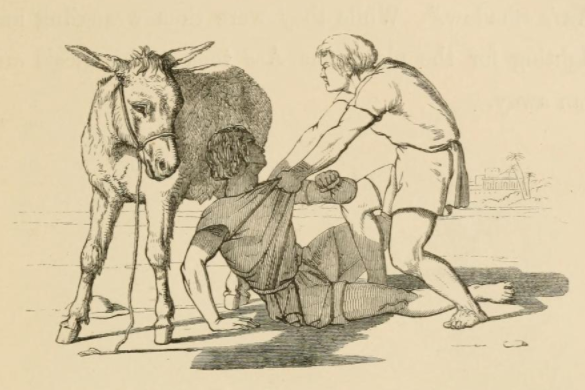
This saying is used to describe something worthless, a trifle of no value whatsoever, and certainly nothing worth arguing about. It was a popular ancient Greek saying as the many citations in Erasmus attest. I especially like the citation from Lucian: Πάντες ὡς ἔπος εἰπεῖν περὶ ὄνου σκιᾶς μάχονται οἱ φιλοσοφοῦντες, "All the philosophers are fighting, as the saying goes, about the shadow of a donkey." Erasmus also reports Demosthenes telling the fable about the donkey's shadow, which you can read here: The Ass's Shadow.

Ὑπὸ παντὶ λίθῳ σκορπίος.
Under every stone (there is) a scorpion.
So, you may want to "leave no stone unturned" (as the English saying advises), but this Greek proverb warns you to be careful when turning over stones: watch out for the scorpion underneath! As you can see, we get the word scorpion in English from the Greek σκορπίος.

Μεταξὺ τοῦ ἄκμονος καὶ σφύρας.
Between the anvil and the hammer.
Compare the English saying, "Between a rock and a hard place" — although I think the hammer-and-anvil of the Greek saying is more intense! Wham! The word μεταξὺ serves a preposition here, but it can also function as an adverb meaning "between-whiles, meanwhile."


Here is Tenniel's illustration for the Aesop's fable about the donkey's shadow

Sunday, April 28, 2024

26: be about to, learn, stay, appear, call upon

Here are today's vocabulary words; they are verbs with the present, future, and aorist stems, plus a brief definition. (If you are just beginning Greek and have not studied the future or aorist stems yet, you can just focus on the present stem.) Click on the word to learn more at Logeion, and there's also a study tips post.

1. μέλλω ~ μελλήσω ~ ἐμέλλησα: be about to, be fated 
2. μανθάνω ~ μαθήσομαι ~ ἔμαθον: learn, understand 
3. μένω ~ μενέω ~ ἔμεινα: stay, remain 
4. φαίνω ~ φανέω ~ ἔφηνα: appear, become 
5. ἐπικαλέω ~ ἐπικαλέσω ~ ἐπεκάλεσα: call upon 

Here are the proverbs and sayings:

Τὸ μέλλον οὐδεὶς ἐκφύγοι.

Ἐὰν μὴ πάθῃς, οὐ μὴ μάθῃς.

Τὰ πάντα ῥεῖ καὶ οὐδὲν μένει.

Ἄνθρακες ὁ θησαυρὸς πέφηνεν.

Ἐν ψύλλας δήξει θεὸν ἐπικαλεῖται. 

Listen at SoundCloud.


Plus some commentary:

Τὸ μέλλον οὐδεὶς ἐκφύγοι.
No one can escape what is coming.
The verb ἐκφύγοι is in the optative mood, expressing potential: people might wish to escape what is coming, but nobody can escape, οὐδεὶς ἐκφύγοι. The participial phrase τὸ μέλλον means "that which is coming," i.e. the future, fate, destiny, etc.

Ἐὰν μὴ πάθῃς, οὐ μὴ μάθῃς.
If you don't suffer, you won't learn.
Compare a similar saying from an earlier blog post: Τα παθήματα μαθήματα. Both πάθῃς and μάθῃς are in the subjunctive, and the use of οὐ μὴ with the subjunctive expresses an emphatic negative prediction, so the saying could even be translated as "you won't ever learn."

Τὰ πάντα ῥεῖ καὶ οὐδὲν μένει.
All things are in flux and nothing lasts.
You are already saw a shorter version of this saying in a previous blog post: Πάντα ῥεῖ.  

Ἄνθρακες ὁ θησαυρὸς πέφηνεν.
The treasure turned out to be charcoal.
The proverb refers to a supposed treasure that turned out to be worthless. It might also be an allusion to a folktale type that is sometimes called "fairy gold" in English, i.e. gold belonging to or given by fairies which disappears or changes into something worthless. You can find the saying in Lucian of Samosata along with a Latin version in Phaedrus's fables: Carbonem, ut aiunt, pro thesauro invenimus.

Ἐν ψύλλας δήξει θεὸν ἐπικαλεῖται.
He calls upon God for the bite of a flea.
This proverb alludes to Aesop's fable about the man who foolishly called upon the divine Hercules for help when a flea bit him, as if a flea bite were worthy of divine intervention!


The fable appears in La Fontaine, and here is an illustration for that fable by Rabier which shows not only Hercules, but also Zeus in the heavenly clouds above... plus decorative fleas down below!

Saturday, April 27, 2024

25: walk, present, able, become, work

Here are today's vocabulary words; they are verbs with the present, future, and aorist stems, plus a brief definition. (If you are just beginning Greek and have not studied the future or aorist stems yet, you can just focus on the present stem.) Click on the word to learn more at Logeion, and there's also a study tips post.

1. βαίνω ~ βήσομαι ~ ἔβην: walk, go 
2. πάρειμι ~ παρέσομαι (no aorist): be present 
3. δύναμαι ~ δυνήσομαι ~ ἐδυνησάμην: be able to 
4. γίγνομαι ~ γενήσομαι ~ ἐγενόμην: be, become, happen 
5. κάμνω ~ καμέομαι ~ ἔκαμον: work, be weary 

Here are the proverbs and sayings:

Ἐν πυρὶ βέβηκας.

Τὴν παρεοῦσαν ἄμελγε.  

Μωρὸς σιωπᾶν οὐ δύναται.

Ἐκ τοῦ ὁρᾶν γίγνεται τὸ ἐρᾶν.

Ἄλλοι μὲν κάμον, ἄλλοι δ᾽ ὤναντο.


Listen at SoundCloud.


Plus some commentary:

Ἐν πυρὶ βέβηκας.
You're walking on fire.
The proverb suits any dangerous situation. More specifically, the idea is that fire can smolder, unseen, beneath the ashes, so you may be walking on fire without even knowing it. Here is Samuel Johnson's rendering of some lines in Horace to that effect: "With heedless feet on fires you go / That hid in treacherous ashes glow."

Τὴν παρεοῦσαν ἄμελγε.
Milk (the cow that is) present. 
The idea is that you should milk the cow (or sheep or goat) that you have; you cannot milk a cow who is not right there at hand. This applies literally to a cow and metaphorically to any situation where you need to make do with whatever it is you actually have available. The advice appears in the bucolic poetry of Theocritus, hence the implied cow (or goat or sheep). The Greek verb ἀμέλγω is related to the English word milk, both deriving from Indo-European h₂melǵ. From the Greek verb πάρειμι comes the noun παρουσία, "presence," which is used as a theological term in English: parousia.

Μωρὸς σιωπᾶν οὐ δύναται.
A fool isn't able to keep quiet.
There are many proverbs which praise the virtue of silence; talking too much is a sign of foolishness. The verb δύναται takes an infinitive complement: σιωπᾶν. From Greek σοφός and μωρός we get English sophomore, which is an oxymoron... and yes, we get the word oxymoron from μωρός also: sharp-dull.

Ἐκ τοῦ ὁρᾶν γίγνεται τὸ ἐρᾶν.
From seeing comes loving.
Note the articles with the infinitive: the infinitive is a noun, and the article tells you the case. So, τὸ ἐρᾷν is nominative, the subject of γίγνεται, "becomes, comes into being, comes," and τοῦ ὁρᾷν is genitive with the preposition ἐκ. 

Ἄλλοι μὲν κάμον, ἄλλοι δ᾽ ὤναντο.
Some did the work, others got the profit.
The Greek ἄλλος... ἄλλος... construction is like the English "some... others..." — and you can also see how it is coordinated in Greek with μὲν... δὲ...


Here is a Greek terracotta vase in the shape of a cow's head: